
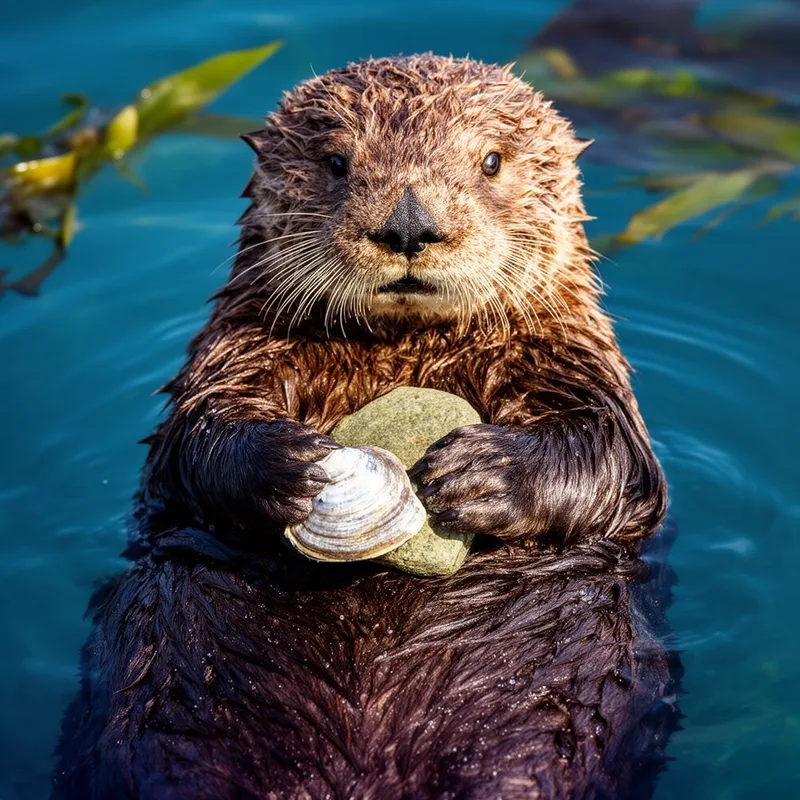
sea otter
 7
2.3
7
2.3

- noun
- /siː ˈɑːtər/
- US
- Marine mammals of the sound include orcas, sea lions (adorable!), sea otters, gray whales, humpback whales, and harbor seals.
Loading YouTube…
Watch on YouTubeAnd what he saw no kelp, no sea otters, no abalone.
- And what he saw no kelp, no sea otters, no abalone.
Examples
-
Enjoy the gray whales swimming offshore, the California condors flying overhead, and sea otters relaxing in kelp beds.
Blog text (27) -
Sea otters can usually be seen from somewhere on the trails, but they move around a lot.
Academic text (2006) -
The California sea otter exhibit will be the first of its kind on the East Coast.
Academic text (1993) -
And I pick up this little sea otter... ...and wipe off the oil from the tanker spill.
-
In order to be "delisted" as threatened, the southern sea otter population would need to exceed 3,090 for three consecutive years.
Blog text (14) -
Wilmers' results suggest that sea otters can substantially alter ecosystem carbon budgets through their indirect effects on plants.
Blog text (14) -
Sea otter predation of sea urchins has led to increased kelp production (Watson and Estes 2011).
Academic text (2013) -
For example, the presence of sea otters (Enhydra lutris) in nearshore communities of the North Pacific is critical to maintaining kelp forests.
Academic text (2009) -
In the absence of sea otters, sea urchin populations increase and graze kelp forests to form urchin barrens.
Blog text (14) -
While kayaking, we spotted a playful sea otter floating on its back, cracking open a shellfish.
Synonyms
A large sea mammal with very thick dark brown fur that lives along the northern Pacific coast
Surface Forms
Morphology
The meaning 'a marine otter' is directly and compositionally derived from 'sea' (saltwater body) + 'otter' (small web-footed carnivore); this noun‑noun compound signals habitat and is a straightforward, literal combination. Such compounding is cross‑linguistically common, so a B1 learner who knows both words can readily infer the MWE's meaning.
Etymology
Sea otter gets its name from the simple image of an otter that lives in the sea. These animals float on their backs and use rocks to open shellfish, so the name helps you remember it is an otter of the ocean.