
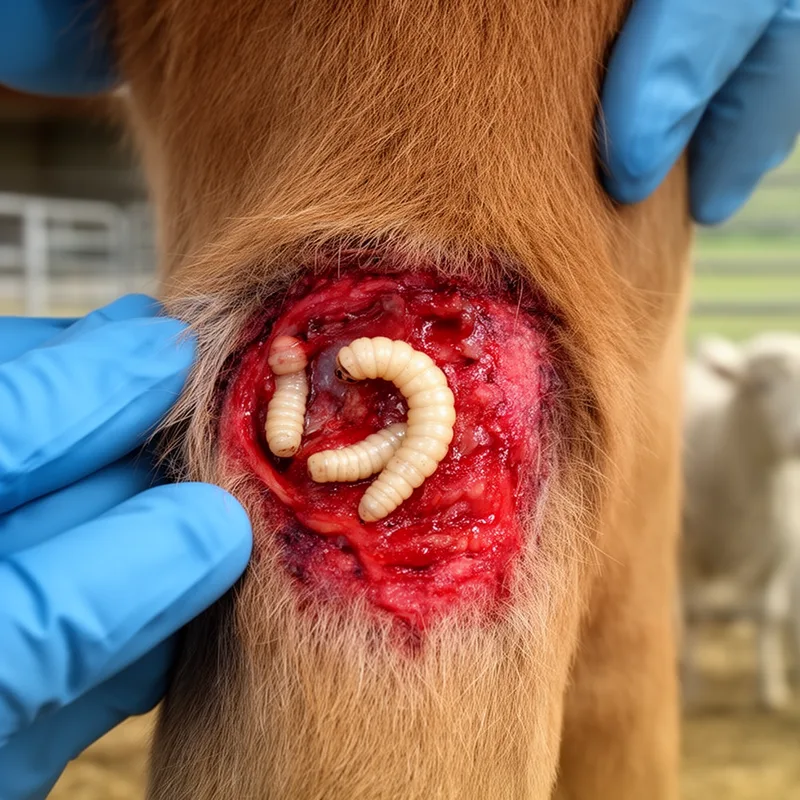
screwworm
 1
9.9

- noun
- /ˈskruːˌwɜːrm/
- NSFW
- Entomologist Edward F. Knipling pioneered research to develop pesticide-free ways to eliminate screwworms.
- eradicate screwworms
Examples
-
Today, countries as far south as Nicaragua are screwworm-free.
Academic text (1998) -
ARS's invention of the sterile male insect release control method was the basis for the eradication of screwworm in the United States in 1982.
Academic text (2006) -
Aruba knew it needed immediate help before the screwworm outbreak problem grew worse.
Academic text (2006) -
Even the format for the boll weevil program took its direction from the screwworm program.
Academic text (2003) -
Shortly after that, similar programs eliminated screwworms from Florida by 1957 and across the southwestern United States in 1962.
Academic text (1996) -
Screwworms were wiped out in tests conducted in 1955 on the island of Curacao, off the coast of Venezuela.
Academic text (1996) -
ARS continues to research ways to eradicate screwworms, but in other countries rather than here, because screwworm has been eradicated south to the barrier zone in Panama.
Academic text (2006) -
Not only was the local livestock industry endangered, but there was concern for the country's number-one industry, tourism, because screwworms can cause untold devastation to all warm-blooded animals, including humans.
Academic text (2006) -
Farmers were worried about the screwworm infestation affecting their cattle's health.
-
The veterinarian explained how screwworm larvae can cause severe wounds in sheep and other livestock.
Synonyms
 1
9.9
A large hairy fly whose larvae grow under the skin of mammals and cause pain

 1
9.5
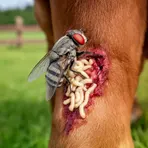
A fly whose young eat the flesh of dead or living animals
 1
9.9
A large fly whose young live under the skin of mammals such as humans and cattle

Large flies whose larvae live under the skin of cattle and cause swellings
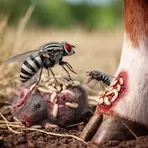
A fly whose larvae feed on dead animals or wounds on living animals
Surface Forms
Etymology
Screwworm joins the simple words screw (like 'twist') and worm (a larva). It was named for larvae that twist into wounds and 'eat' living flesh, so the name fits the parasitic fly larva that causes serious wounds.