
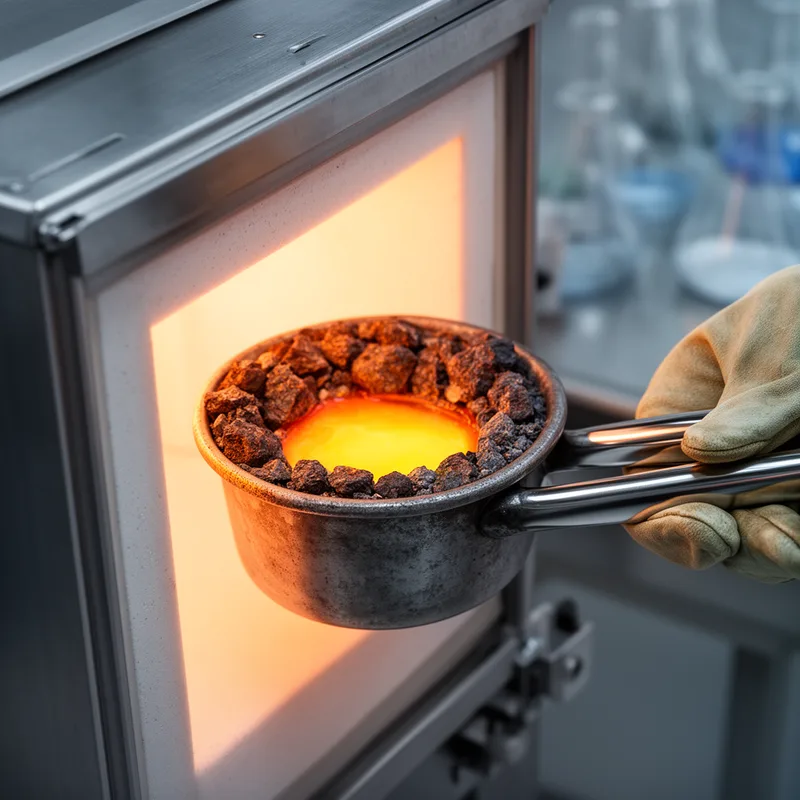
scorifier
- noun
- /ˈskɔːrɪfaɪər/
- Specialized
- To analyze the ore, the metallurgist placed it in a scorifier and heated it until the minerals fused.
- scorifier and crucible
Examples
-
They would have melted an ore sample in the thermal-resistant crucible, carried out an intermediate reaction, such as concentrating the noble metals in the scorifier, and further refined the metal in the cupel.
Academic text (2004) -
PHOTO (COLOR): The array of specialized artifacts found at the Oberstockstall castle in Lower Austria included cupels, scorifiers, crucibles, muffles, flasks, still heads, and cucurbits.
Academic text (2004) -
On the other hand, the scorifiers were made of less refractory clay than the crucibles and had a wide variety of other materials, which meant that the reactions carried out in them didn't need temperatures as high.
Academic text (2004) -
The lab technician selected a scorifier to mix the test samples with the flux for the melting process.
-
In the metallurgy experiment, the scorifier was essential for conducting high-temperature tests of the metal.
Surface Forms
Morphology
scorifier = scorify (semi-transparent) = scorify + er
The formation 'verb + -er' to denote an instrument is regular, but the base verb and root ('scorify'/'scoria') are rare technical terms, so derivation may not be obvious to most learners.
Etymology
The word scorifier comes from the Latin root scoria, which means 'slag' or the waste left when metal is melted. So a scorifier is the small pot used to melt ore and let the 'slag' separate from the metal.

