
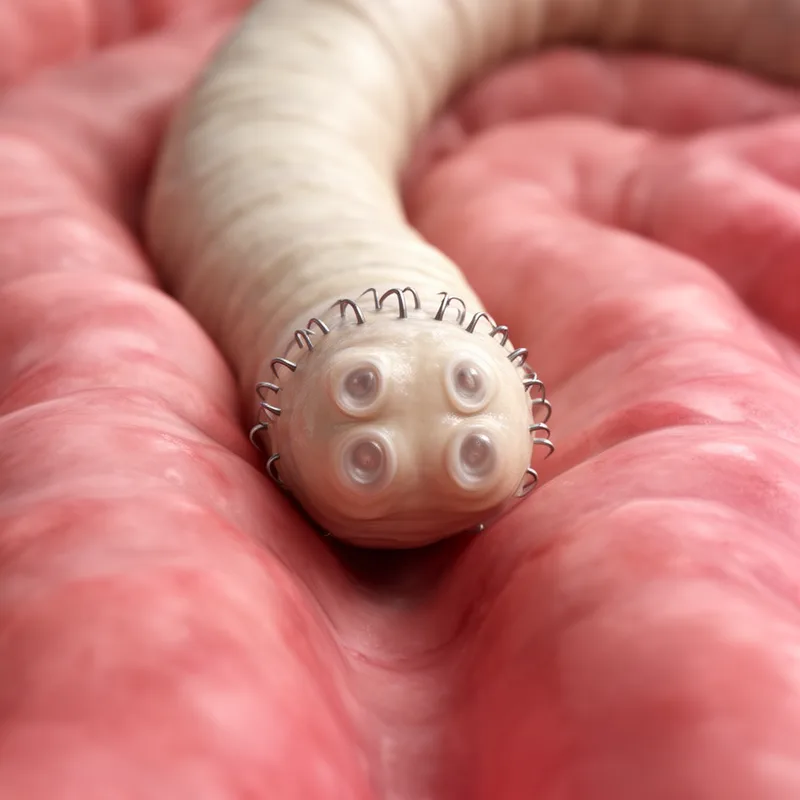
scolex
 1
9.9

- noun
- /ˈskoʊlɛks/
- Specialized
- It clearly displays all four scolex (pointed by green arrows), calcified nodules (pointed by yellow arrows), and inflammatory response as edema (marked with a circle).
Examples
-
CT shows a cystic wall of small and rounded cysts with little mass effect, whereas MRI presents a well-visible eccentric scolex 2,14.
Academic text (2016) -
Enhanced CT can present multiple, larger live cysts with eccentric scolex, parenchymal lesions, and ring-like lesions.
Academic text (2016) -
It also gives a better appearance of the scolex than that of CT.
Academic text (2016) -
These cysts have viable larvae in the form of the scolex.
Academic text (2016) -
It is also the best modality to detect extra-parenchymal NCC and scolex 17.
Academic text (2016) -
The scolex, or head, of this species adheres to the host's intestine with rounded attachment structures, each one edged with a row of suckers.
Academic text (2000) -
High-resolution ultrasonography showing moving larva or an anechoic area with a calcified scolex is another useful non-ionizing imaging modality for diagnosing this condition.
Academic text (2009) -
The scolex of the tapeworm is equipped with hooks that help it attach firmly to the host's intestine.
-
In studying parasitology, we learned that the scolex serves as the anchor point for the tapeworm.
-
The researcher examined the scolex, noting the presence of suckers that allow the organism to latch onto its host.
Surface Forms
Etymology
Scolex comes from an old Greek word skolex meaning 'worm'. So, scolex names the tapeworm's 'head' because this small 'worm' head has hooks and suckers that hold the parasite to its host.