

schist
 2
9.6
2
9.6

- noun
- /ʃɪst/
- Specialized
- The main rivers are deeply incised in schists and granites, producing a gently undulating landscape with slope gradients that increase near the main streams.
- mica schist
- garnet schist
- Manhattan schist
Examples
-
The rest of the catchment area is occupied exclusively by outcrops of schist.
Academic text (2002) -
Look at all this schist.
-
Large piles of schist and other stone fragments indicate the intensity of activity that once took place here.
Academic text (2002) -
Toward the evening of the day following, they came upon a canted dyke of gray schist which, rising and falling, created a chain of rocky islands across the swamp.
Fiction book (1993) -
To climb the summit, we clamber along a schist-filled trail as it weaves around the bottom of a cavernous glacial cirque.
Academic text (2007) -
The geologist explained that schist is a type of metamorphic rock known for its distinct layered structure.
-
As we hiked up the mountain, we noticed large slabs of schist that made the trail rough and exciting.
-
You can easily identify schist by its flaky layers that are a result of its mineral composition.
Synonyms
 1
3.9
1
3.9
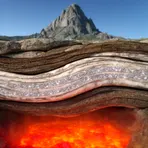
A rock changed by heat and pressure inside the earth
How Metamorphosed
- Specialized

 1
9.9
1
9.9

- Specialized
2
9.6
61
5.7
- Specialized
- Specialized
3
3.5
Surface Forms
Etymology
The word schist comes from an old Greek word meaning 'to split' and is related to the English word schism ('a split'). So, schist is named for the way it easily splits into thin, flaky layers.