
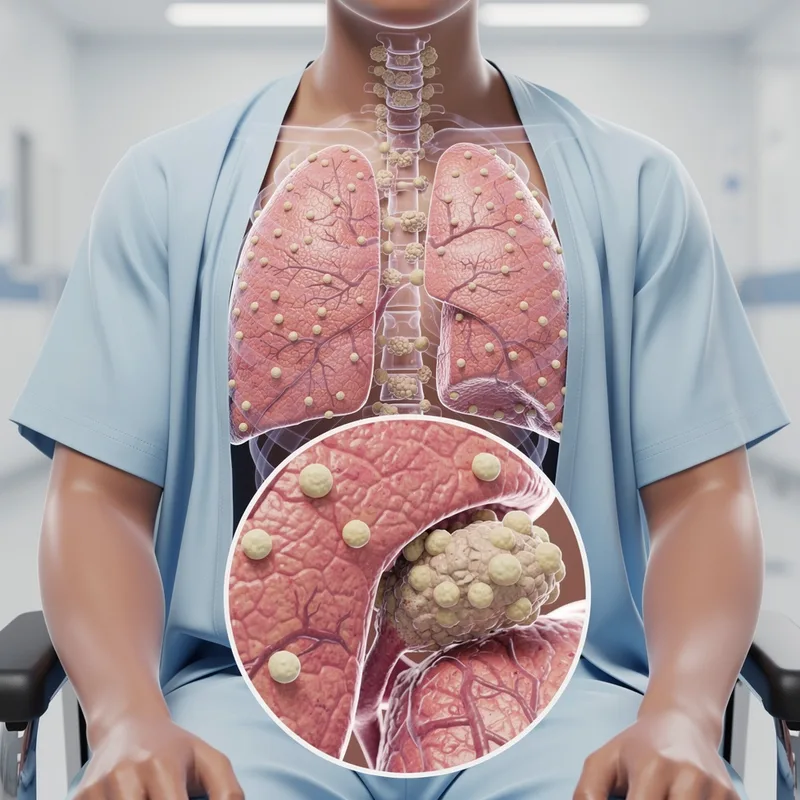
sarcoidosis
 5
9.9

- noun
- /ˌsɑr.kɔɪˈdoʊ.sɪs/
- Specialized
- Establishing the diagnosis of sarcoidosis primarily involves the methodical elimination of other causes of granulomatous inflammation.
- sarcoidosis patients
- diagnosis of sarcoidosis
- manifestations of sarcoidosis
Loading YouTube…
Watch on YouTubeLyme disease is a rare but known cause of peripheral neuropathies, sarcoidosis and then small vessel vasculitis.
- Lyme disease is a rare but known cause of peripheral neuropathies, sarcoidosis and then small vessel vasculitis.
Examples
-
A staging system for sarcoidosis of the sinonasal tract has been recently proposed.
Academic text (1998) -
A diagnosis of sarcoidosis was made, and the patient was started on intravenous steroid therapy.
Academic text (2008) -
Unfortunately, the clinical signs associated with sarcoidosis are relatively nonspecific as well.
Academic text (1998) -
Sinonasal manifestations of sarcoidosis have been reported in 1 to 4% of patients.
Academic text (2008) -
The overall incidence of sarcoidosis has been reported to range from 1 to 40 cases per 100,000 population.
Academic text (2003) -
The patient was referred to a respiratory physician for further management, and sarcoidosis was confirmed on transbronchial biopsy.
Academic text (2003) -
The most common head and neck manifestation of sarcoidosis is cervical lymphadenopathy.
Academic text (2008) -
Differential diagnosis at this stage included an infective cause, sarcoidosis, connective tissue disease, or lymphoma.
Academic text (2007) -
Between one-fourth and one-half of sarcoidosis patients experience generalized lymphadenopathy, but splenomegaly is rare.
Academic text (1998) -
Many patients with sarcoidosis experience difficulty breathing due to its effects on the lungs.
Synonyms
 1
9.9
A condition where small areas in the body become swollen and sore
A sickness that makes small grain-like spots form in body tissues
Surface Forms
Morphology
sarcoidosis = sarcoid (opaque) = sarco + oid + osis
The immediate base 'sarcoid' and its components are technical medical combining forms unfamiliar to average learners and do not transparently indicate a disease meaning.
Etymology
Sarcoidosis comes from the Greek root sarx meaning 'flesh' and the ending -osis meaning 'a condition'. Doctors named it this because the disease makes small, flesh-like lumps in the body's organs, especially the lungs, so sarcoidosis is a 'condition of the flesh' that explains the nodules it forms.