

sandarac tree
- noun
- /ˈsændəræk tri/
- The sandarac tree provides a resin that is valued in fine varnish making.
Examples
-
Old cabinets were often finished with lacquer containing sandarac tree resin.
-
The sandarac tree grows tall in the Mediterranean region.
-
In parts of Morocco, the sandarac tree plays an important role in traditional crafts.
-
Many sandarac trees can be found in Morocco.
-
In parts of Morocco, the sandarac tree plays an important role in traditional crafts.
-
The sandarac tree provides a resin that is valued in fine varnish making.
-
Old cabinets were often finished with lacquer containing sandarac tree resin.
Synonyms

A large evergreen tree from North Africa and Spain that gives hard, fragrant wood and resin used in varnish

A large evergreen tree from North Africa that gives fragrant wood and resin
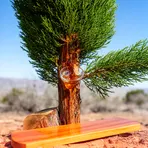
A large evergreen tree with small flat leaves like scales and fragrant hard wood that gives resin for varnish
Surface Forms
Morphology
The phrase denotes a tree of the sandarac species, so the meaning is directly compositional from 'sandarac' (the specific resin-producing conifer) + 'tree' (a tall perennial plant). This noun‑noun naming pattern is common and cross-linguistically transparent, so a learner who knows both constituents will readily understand the expression.
Etymology
The sandarac tree is a tree from North Africa and Spain whose bark gives a sticky, fragrant resin. That resin was used for fine 'varnish' and 'lacquer', so the name became linked to both the tree and the valuable material it produces.

