
samizdat


 1
9.9
1
9.9
- noun
- /ˈsæmɪzˌdɑt/
- There were also the voices of dissenters, beginning during the Nikita Khrushchev years, who wrote without the eye of the censor, circulating their writings in samizdat form, having lost their fear of prison.
- the underground press, or samizdat
Examples
-
Although it is common to think that the human rights movement initiated the use of samizdat after the trial of Andrei Siniavsky and Yuli Daniel in 1966, the Christian churches actually led the way.
Academic text (1991) -
Back in 1969, the Western publication of The Rise and Fall of T. D. Lysenko, which originally circulated reader-to-reader as a samizdat book, cost Medvedev his job and made him an exile.
Academic text (2013) -
To my knowledge, this work has not appeared in print, neither through "official" publication at a press nor in samizdat unofficial print reproduction.
Academic text (1997) -
The controlled press was countered by the presence of samizdat, or self-publishing.
Academic text (1993) -
Alternative sources were either underground (Samizdat) or smuggled from abroad.
Academic text (2010) -
For many reasons, the samizdat literature that flourished in Poland, Czechoslovakia, and Russia did not exist in the G.D.R.
Academic text (1993) -
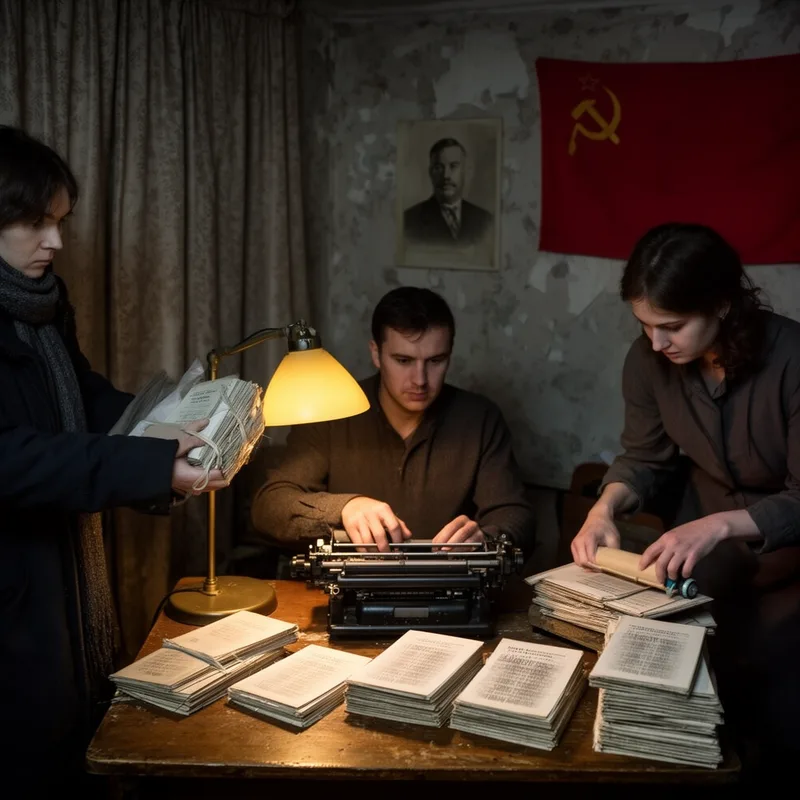
A widespread phenomenon in the early 1970s and 1980s, samizdat usually consisted of typewritten carbon copies of censored literature, poetry, and political thought.
Academic text (1993) -
During the Soviet era, many authors risked their freedom to produce samizdat literature that challenged the government.
-
In the dark corners of apartments, people secretly circulated samizdat that contained banned writings and dissenting opinions.
-
The samizdat movement played a crucial role in the spread of underground ideas during the oppressive regime.
Synonyms
 1
7.8
1
7.8
A secret way of printing and sharing banned or critical writing
Surface Forms
Etymology
The word samizdat comes from Russian parts sam 'self' and izdat 'publish', so it literally means 'self-published'. In the Soviet era people secretly copied and shared banned books and ideas, so samizdat now means the secret copying and sharing of banned writing.