
sacred ibis
- noun
- /ˈseɪkrɪd ˈaɪbɪs/
- South African
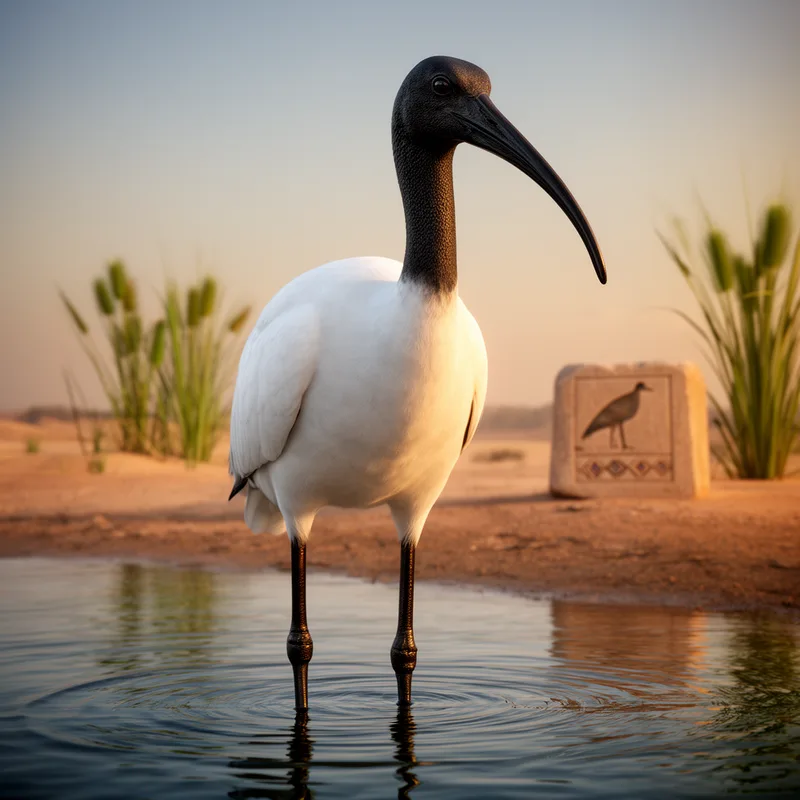
- The sacred ibis was commonly depicted in ancient Egyptian art and hieroglyphics.
Examples
-
A flock of sacred ibises waded along the banks of the Nile at sunset.
-
Many sacred ibises were found in ancient Egyptian tombs.
-
The museum’s ornithology section features a well-preserved sacred ibis specimen.
-
The sacred ibis is often seen near the Nile River.
-
A flock of sacred ibises waded along the banks of the Nile at sunset.
-
The sacred ibis was commonly depicted in ancient Egyptian art and hieroglyphics.
-
Many sacred ibises were found in ancient Egyptian tombs.
Synonyms

A white African bird with a long curved beak and a black head and neck
Surface Forms
Morphology
The compound simply combines 'sacred' (venerated) and 'ibis' (a wading bird) to denote an ibis that is held in high respect; the MWE’s meaning is directly inferable from its parts. This type of noun + modifier composition is cross-linguistically common, so a B1 learner who knows both words would readily understand the phrase.
Etymology
Sacred ibis comes from ancient Egypt, where people saw the white bird, the ibis, as holy, so the word sacred was used because the bird was connected to the god Thoth and was often wrapped and buried for religious reasons. So the name shows it is an ibis that people once treated as 'holy'.

