
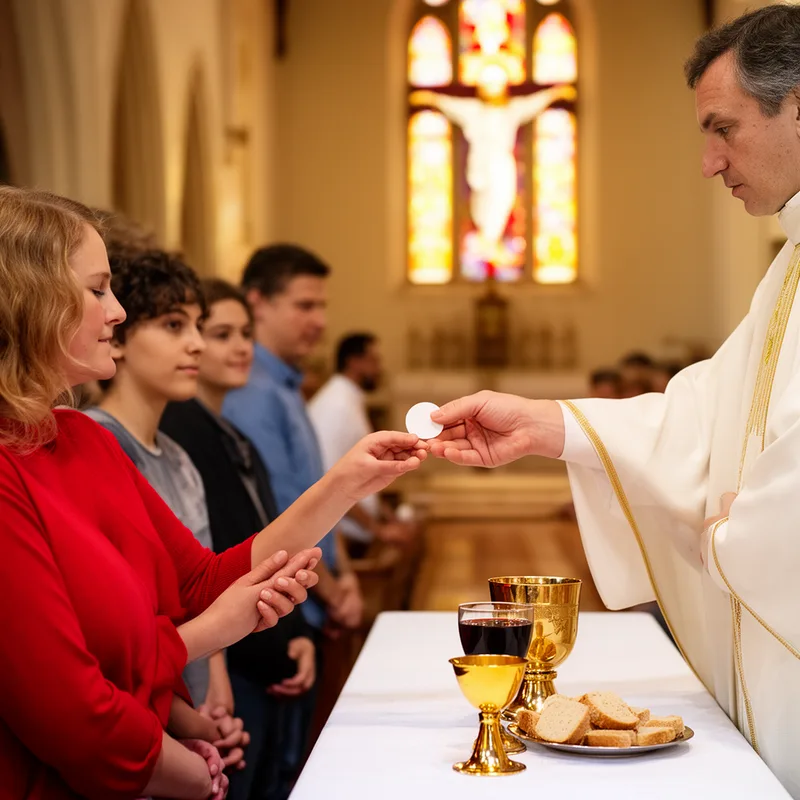
sacrament of the Eucharist
- noun
- /ˈsækrəmənt əv ði juˈkərɪst/
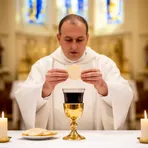
- During the Mass, congregants receive the sacrament of the Eucharist to commemorate Jesus Christ's Last Supper.
Examples
-
In the former, we read that "the sacrament of the Eucharist is not only a fraternal meal (the adjective is noteworthy), but at the same time the memorial which makes present and actual Christ's sacrifice and his offering by the Church."
Academic text (1995) -
People go there to have crosses and portraits of Our Lady blessed, to make confessions, and to receive the sacrament of the Eucharist.
Academic text (1990) -
She appears to kneel at her priedieu as though perpetually participating in the sacrament of the Eucharist.
Academic text (1994) -
Such a union—the sacrament of the Eucharist, which revolves tightly around the miracle of transubstantiation—is the core and culmination of the major church activity, Mass.
Academic text (1992) -
The priest explained the significance of the sacrament of the Eucharist in his homily on the importance of faith.
-
In the Catholic Church, the sacrament of the Eucharist is celebrated as a way to remember the sacrifice of Jesus.
Synonyms

 104
4.9
104
4.9

A Christian church service where people receive bread and wine to remember Jesus
 17
9.3
17
9.3
A Christian service when people bless and eat bread and drink wine to remember Jesus' Last Supper
 9
4.9
9
4.9
A Christian ceremony where people share bread and wine to remember Jesus
 8
6.3
8
6.3
A Christian ceremony when people eat bread and drink wine to remember the Last Supper
 4
9.1
4
9.1
A Christian ceremony that blesses bread and wine to remember the Last Supper
 2
7.7
2
7.7
A Christian ceremony where people share bread and wine to remember the meal Jesus had before he died
 1
8.1
1
8.1
A Christian ceremony when people bless and eat bread and wine to remember Jesus' Last Supper

 1
9.8
1
9.8
A religious ceremony where Christians bless bread and wine to remember Jesus' Last Supper

A Christian ceremony where bread and wine are blessed and eaten to remember Jesus' Last Supper

A Christian service in which people receive bread and wine to show unity

An old Christian ceremony where people receive bread and wine
Surface Forms
Morphology
sacrament + of + the + Eucharist
The phrase simply combines 'sacrament' (an outward sign or religious rite) with 'Eucharist' (the ritual of consecrated bread and wine), so its meaning as the sacramental rite associated with the Eucharist is directly derivable from the constituent words. This noun-of-noun composition is cross-linguistically common, so a B1 learner who knows both words can infer the basic meaning (though deeper theological nuances would require background knowledge).
Etymology
The sacrament of the Eucharist comes from Jesus' last meal with his friends, the 'Last Supper', when he broke bread and shared wine. He said they stood for his body and blood and told them to do this to 'remember' him, so today Christians eat the bread and drink the wine in church to 'remember' Jesus.