

running board
 3
5.9
3
5.9

- noun
- /ˈrʌnɪŋ bɔrd/
- Archaic
- The old car had a sturdy running board that made entering and exiting easier.
- car with running boards
- truck's running board
- foot on the running board
Examples
-
As the truck began to move, Ruth jumped from the running board and stood to one side while they backed onto the rut road.
Fiction book (2002) -
A truck's a little harder because it's high, but the running board's a big help.
Fiction book (1995) -
The person was standing with one foot up on the running board.
Fiction book (1999) -
I set foot on the running board.
Fiction book (2002) -
A young man sat on the running board.
Fiction book (1990) -
Suddenly and without warning, he hops up on the running board of the car.
Fiction book (1993) -
I felt a little woozy, so I sat down on the truck's running board.
Fiction book (1991) -
Charlie smiles and waves with one foot up on the running board of a 1939 roadster.
Fiction book (1991) -
Kelso pulled Duck out of the back seat and propped him up on the running board.
Fiction book (1991) -
Jeff runs to the Peterbilt and jumps on the driver's side running board, grasping the door handle.
Fiction book (1997)
Synonyms
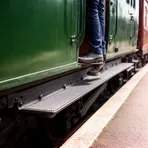
A narrow board to rest your feet on, often on trains
How Wide

Surface Forms
Morphology
Although 'running' + 'board' signals a board associated with running or that runs along something, a B1 learner who knows the constituent words would be unlikely to infer the specific sense 'a narrow step fitted beneath doors to aid entry/exit.' The modifier 'running' here has a conventional spatial extension ('runs along the side') rather than the literal sense of moving, so the relation is partially transparent but the functional meaning (a step) is not fully predictable.
Etymology
The noun running board comes from early cars: the word running means moving along the side and board is the long step fixed under the door that people used to 'get in'. That's why running board means a narrow step under the doors to help someone 'get in' or 'get out'.