
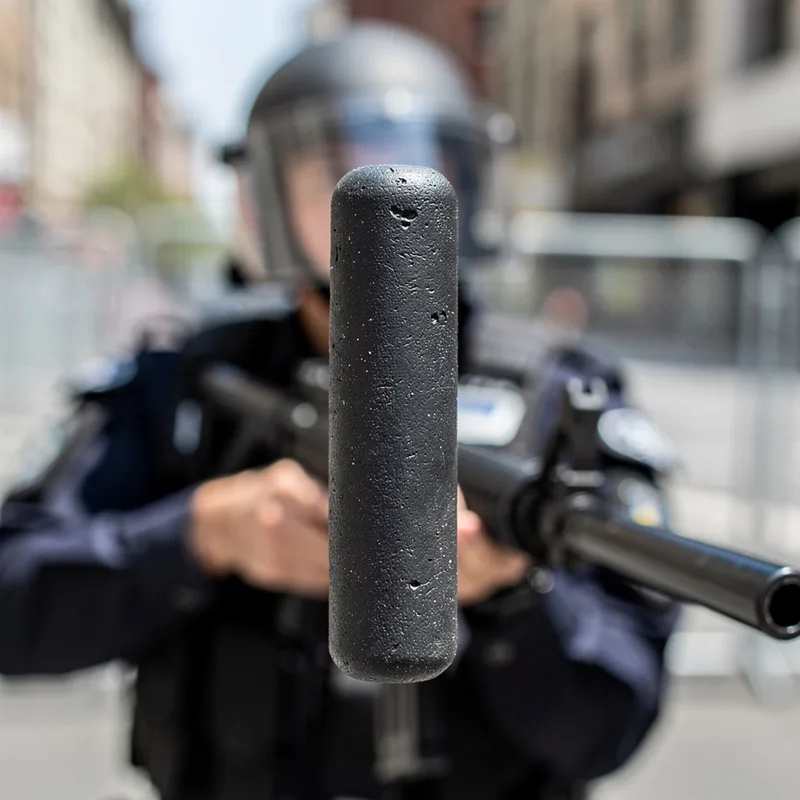
rubber bullet
 11
3.8
11
3.8

- noun
- /ˈrʌbər ˈbʌlɪt/
- Officers at Cibeles Square in the city center fired rubber bullets and used batons against protesters.
- tear gas and rubber bullets
- gas canisters and rubber bullets
Loading YouTube…
Watch on YouTubeLiterally open the front door and they lit the whole house up and they shot my mate with a rubber bullet.
- Literally open the front door and they lit the whole house up and they shot my mate with a rubber bullet.
- You got the, the, the rubber bullets, the tear gas canisters, all that crap.
Examples
-
During the protest, the police used rubber bullets to control the crowd without causing lethal harm.
-
At the beginning of 1990, a new rubber bullet with greater range and impact was introduced.
Academic text (1991) -
Some medics were hit by rubber bullets.
Academic text (2001) -
In Manokwari, the security forces fired rubber bullets at students, injuring at least eight.
Blog text (15) -
Police retake Capitol Hill, but some say amid the tear gas and rubber bullets, they have lost credibility.
-
Armored riot police arrived shortly thereafter, firing rubber bullets and tear gas grenades to disperse the crowd.
Blog text (34) -
The crowd dispersed quickly when officers began firing rubber bullets into the air.
-
Students were startled when they learned that rubber bullets could be used for crowd control during university protests.
How Harmful

Surface Forms
Morphology
rubber + bullet
The meaning 'a bullet made of rubber' is directly and compositionally derived from 'rubber' (the material) + 'bullet' (a projectile). This is a literal noun–noun compound following common English compounding patterns, so a B1 learner who knows both constituents can readily infer the MWE meaning.
Etymology
Rubber bullet comes from a clear picture: a bullet made of rubber so it can hurt but not kill. Police and soldiers used these softer bullets to break up crowds, so today the phrase means 'a bullet meant to hurt but not to kill, used to control crowds'.