
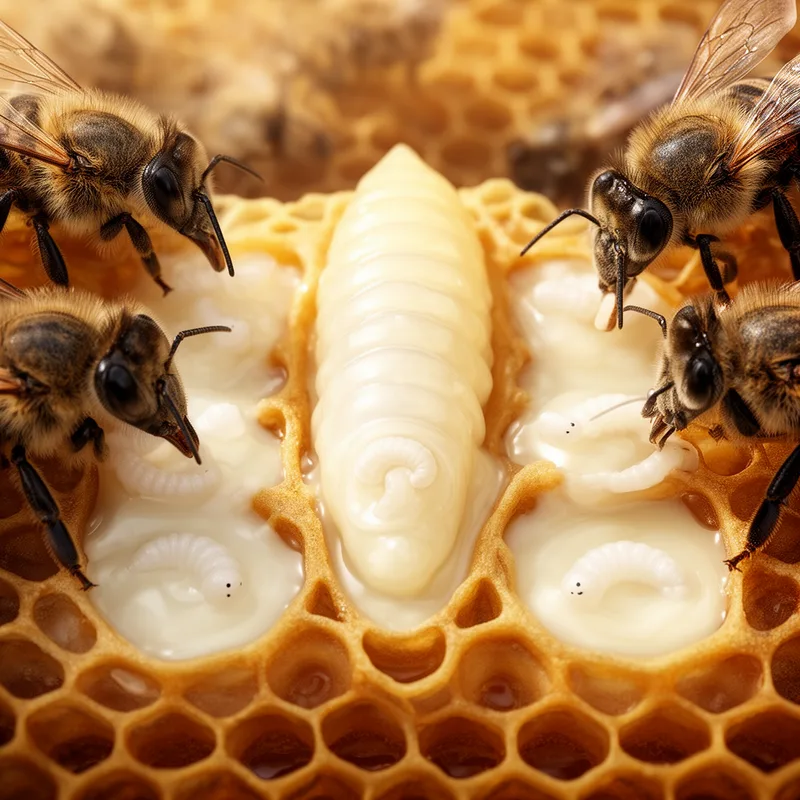
royal jelly
 2
6.8
2
6.8

- noun
- /ˈrɔɪəl ˈdʒɛli/
- Specialized
- In the hive, nurse bees produce royal jelly to feed the queen and her larvae.
- royal jelly fed to queens
- royal jelly diet
- fed royal jelly
Loading YouTube…
Watch on YouTubeThis one also has royal Jelly and bee pollen and bee venom in.
- This one also has royal Jelly and bee pollen and bee venom in.
- So all that happened in the developing bees was how long they were fed royal Jelly for.
Examples
-
Royal jelly secretions from young (nurse) bees are fed via oral trophallaxis to growing larvae and the queen.
Academic text (2018) -
A successfully mated queen is fed massive amounts of royal jelly as she begins to lay eggs.
Academic text (2018) -
But you think royal jelly can be beneficial in some cases?
-
In turn, the royal jelly diet provides defense against oxidative damage.
Academic text (2018) -
You've done some work on royal jelly, haven't you?
-
She should take royal jelly, one capsule every morning.
-
The antimicrobial properties of royal jelly may be more manifest in the mouth and midgut.
Academic text (2018) -
Nurse workers gorge on pollen to synthesize royal jelly fed to queens throughout their lives.
Academic text (2018) -
Long-lived (queen) phenotypes are fed royal jelly throughout their lives to replenish internal levels of vitellogenin.
Academic text (2018) -
Royal jelly is functionally analogous to mammalian breast milk, comprised of a complete diet and antioxidant, antimicrobial, and immunoregulatory properties.
Academic text (2018)
Synonyms
Food made by worker bees from nectar and pollen for young bees
Surface Forms
Morphology
royal + jelly
The compound is compositionally transparent: 'royal' (= relating to a king/queen) plus 'jelly' (a gelatinous substance) yields the idea of a special jelly associated with royalty. Although the referent is a specific bee secretion, the meaning 'a jelly used for/produced for the queen' is directly inferable by a B1 learner who knows both constituents and similar compounds exist cross-linguistically.
Etymology
The noun royal jelly is a creamy food made by worker bees and fed only to the baby bees that will become queens. Because it helps those bees grow big and live longer, people called it royal for the queens and jelly for its soft, creamy look, and some people still use it as a health supplement today.