

round-trip light time
- noun
- Specialized
- Because of the round-trip light time, communication with the probe is delayed by several minutes.
Examples
-
The round-trip light time to Mars can be over 24 minutes depending on the planets' positions.
-
Scientists calculate the round-trip light time before sending commands to distant spacecraft.
-
The round-trip light time to Mars is approximately 22 minutes.
-
What is the round-trip light time to the nearest star?
-
The round-trip light time to Mars can vary significantly based on its distance from Earth.
-
Engineers must consider the round-trip light time when programming commands for remote space probes.
-
Understanding the round-trip light time is essential for effective communication with distant spacecraft.
Synonyms
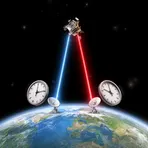
Time it takes for a signal to go from Earth to a spacecraft and back
How Long
- Specialized

- Specialized
- Specialized
- Specialized


 1
8.1
1
8.1
Surface Forms
Morphology
The phrase is directly built from 'round-trip' (a journey there and back) + 'light' (electromagnetic radiation / the speed of light) + 'time' (duration), so the meaning — the duration for light to travel to a target and back — is predictable from the parts. Although it's a technical term, the composition is transparent and similar constructions exist in other languages, so a B1 learner who knows the constituents can reasonably infer the meaning.
Etymology
Round-trip light time shows a simple picture: a light signal leaves Earth, reaches a spacecraft, and then comes back, so the light makes a round-trip and the time is how long that journey takes. That's why the phrase measures the 'delay' before Earth gets an answer from a distant spacecraft.