

roll film
 1
3.9
1
3.9

- noun
- /roʊl fɪlm/
- Archaic
- Many enthusiasts prefer to use 35mm roll film for its rich color and texture.
- 120 roll film
Examples
-
It is available in 16mm and 35mm roll film.
Academic text (1995) -
If you've ever glanced through the ads from the mail-order firms, you've seen quite clearly that the "roll film" or "medium format" and larger cameras are substantially more expensive than the 35s.
Academic text (1997) -
The most important change in photography since photography went from glass plate negatives to roll film!
Academic text (2006) -
Brovnik looked around the room at all the prints; most were square, two-and-a-quarter format, and would have been shot on 120 roll film.
Fiction book (1993) -
Roll film cameras accept 120 (and possibly 220) film.
Academic text (1997) -
Diane began photography as an 11-year-old with a 127 roll film camera but switched to 35mm photography in 1981.
Academic text (2005) -
The introduction of roll film revolutionized the way photographers captured moments.
-
Before the availability of roll film, photographers had to use glass plates for their images.
Synonyms
 301
2.5
301
2.5
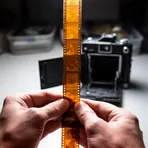
A thin strip coated with chemicals that react to light for photos

 1
3.1
1
3.1
A thin strip of material that cameras use to take pictures with light
How Long

Surface Forms
Morphology
The meaning is directly compositional: 'roll' (an item wound) + 'film' (photographic strip) yields a film wound on a spool, so a B1 learner who knows both words can infer the MWE meaning. This noun–noun composition is a common, cross-linguistic pattern (e.g. 'roll of film'), making the expression immediately transparent.
Etymology
Roll film comes from the way photographers stored film: long film was wrapped into a roll around a small tube so it could fit inside a camera. Because the film was literally on a 'roll', the name came to mean the ready to use film you load into a camera.