
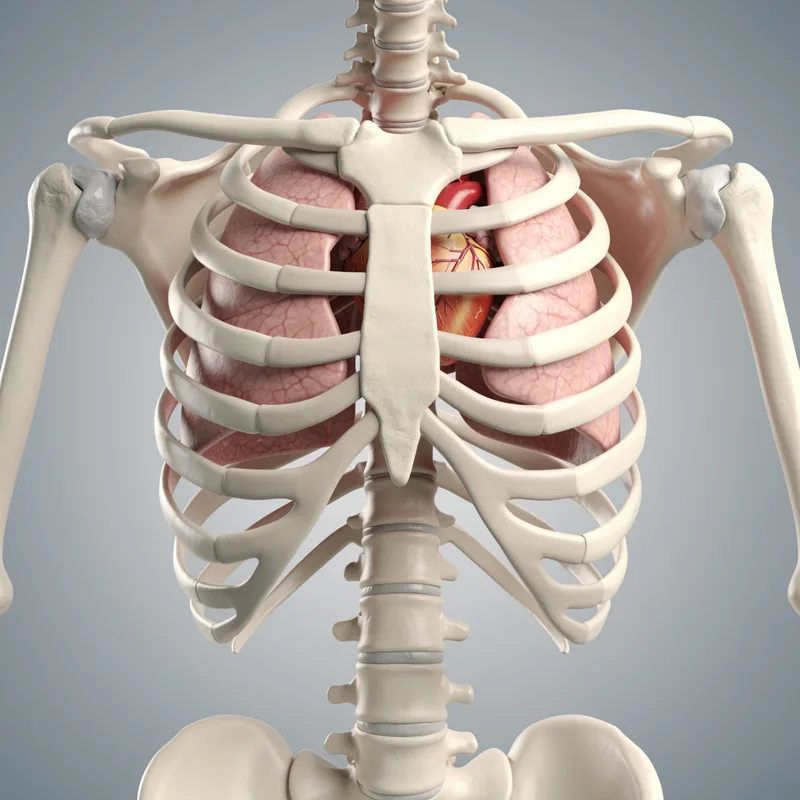
rib cage
 15
2.8
15
2.8

- noun
- /rɪb keɪdʒ/
- The rib cage protects vital organs like the heart and lungs.
Loading YouTube…
Watch on YouTubeSo the idea is that our diaphragm rests underneath our rib cage and we want to get that to be able to fully expand lower and lift.
- So the idea is that our diaphragm rests underneath our rib cage and we want to get that to be able to fully expand lower and lift.
- The lung wants to expand at the same time the rib cage is going to rotate up and out and therefore expanding the the cavity, the thoracic cavity.
- What expanding the belly does is it allows the the rib cage, the bottom ribs to open up outwards like this and then the intercostals open this way.
- And that's on having a wide rib cage and no boobs lol.
- You know, that's that's it, Not their rib cages came out and back into their body.
- And love will fucking Just Dance all up in you, all up in your rib cage and in your brain.
- I was like, sorry, you were trying to injure taking out his fucking rib cage and taking a picture.
- You know, when the man told me, one of the doctors told me when I was a child that that I had the rib cage of a large, large cat.
- So now I put my hands like this to the side of my rib cage and do something called the Whispered Awe.
- They don't usually have my very small bra cup to match such a such a rib cage size.
- The muscle contracts and creates the desired push, but proximal it connects to my rib cage.
Examples
-
We have the cranium protecting the skull, protecting the brain, and we have our rib cage protecting the heart and lungs.
-
So the skull protects the brain, the rib cage protects the heart and lungs.
-
To get at your heart, they split your whole rib cage open.
Fiction book (1990) -
You push on the chest roughly around the top of the rib cage, and then you blow into the mouth.
-
Those were two tremendous right hands to the rib cage.
-
I think I pulled a muscle in my rib cage.
-
His lungs were squeezed in his rib cage so that each breath was extremely difficult.
Fiction book (2000) -
You're going to raise your shoulders, breathe all the way in, expand your rib cage, and then just relax.
-
As the earth pack reached his chest and constricted his rib cage, Francis feared he was being buried alive.
Fiction book (2000) -
A fearful, icy sensation spread under his rib cage and would not leave.
Fiction book (1993)
Synonyms
 6
2.3
6
2.3
Curved bones in the chest that protect the heart and lungs
Surface Forms
Morphology
The compound 'rib cage' is directly interpretable from its parts: 'rib' (the curved bones) + 'cage' (an enclosing structure), so a learner who knows both words can infer it denotes the bones forming an enclosure around the chest. This noun+noun composition and the cross-linguistic tendency to describe the thorax as a ‘cage’ make the meaning immediately comprehensible to a B1 learner.
Etymology
Rib cage comes from the simple picture of the curved ribs making a cage around the chest. Like a cage's bars, they hold and 'protect' the heart and lungs, so the name means the bones that keep the chest safe.