
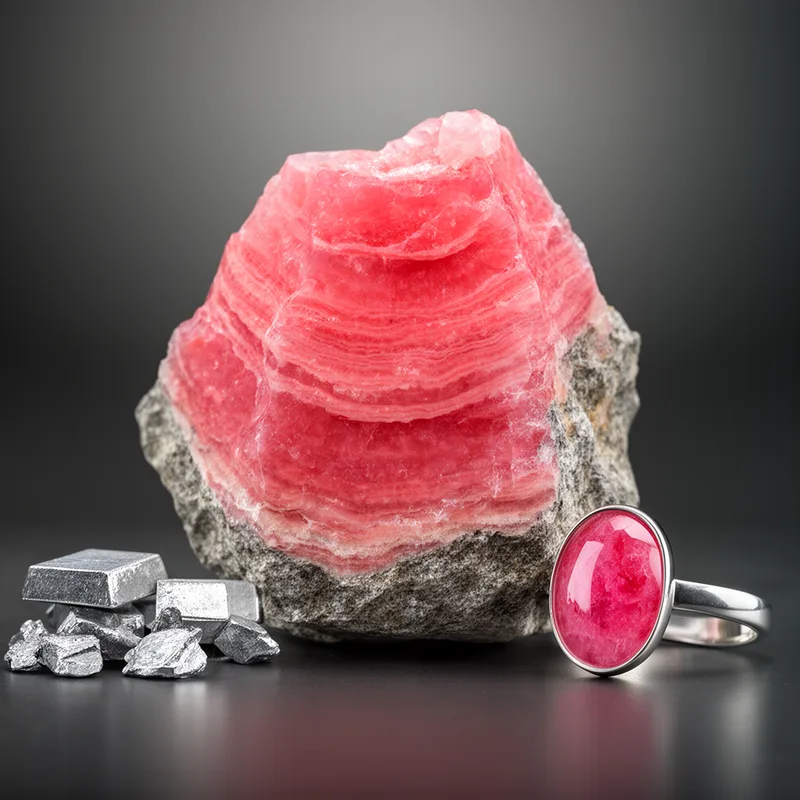
rhodochrosite


 1
9.9
- noun
- /ˌroʊdəˈkroʊsaɪt/
- Specialized
- DIAGRAM: 3 Gnomonic projection of Laue pattern of rhodochrosite (MnCO3) (from Wheeler Davey, A Study of Crystal Structure and its Applications, New York, 1934, fig. 13)
Examples
-
Over time, water had risen to within fifteen feet of the 1,200-foot level, where Marquez worked the rhodochrosite vein.
Fiction book (2001) -
Many collectors seek out rhodochrosite for its vibrant color and crystal formations.
-
Twenty feet beyond was the rhodochrosite lode he was mining.
Fiction book (2001) -
Rhodochrosite is seldom seen in cut or faceted form.
Fiction book (2001) -
The gemstone in its natural state, Marquez recognized, was rhodochrosite, a spectacular crystal found in various parts of the world in shades of pink and deep red.
Fiction book (2001) -
To be exact, the Miller indices in the gnomonic projection in Fig. 3 could be used to draw a picture of a plausible appearance of a crystal of rhodochrosite, since the physical appearances of individual crystals of any given substance may vary widely.
Academic text (1995) -
The beautiful pink mineral rhodochrosite is often used in making unique jewelry pieces.
-
In geology classes, students learn about rhodochrosite as an important source of manganese.
Surface Forms
Morphology
rhodochrosite = rhodo + chros + ite
Built from Greek combining forms ('rhodo-' + 'chros-') plus the mineral suffix '-ite'; these are not standalone English words and the meaning is not transparently derivable for an average B1 learner.
Etymology
Rhodochrosite comes from Greek parts rhodo- 'rose' and -chros- 'colour', plus the mineral ending -ite, like in graphite. So it literally means 'rose-coloured stone', which is why rhodochrosite is a pink to red mineral sometimes used as a gemstone.