
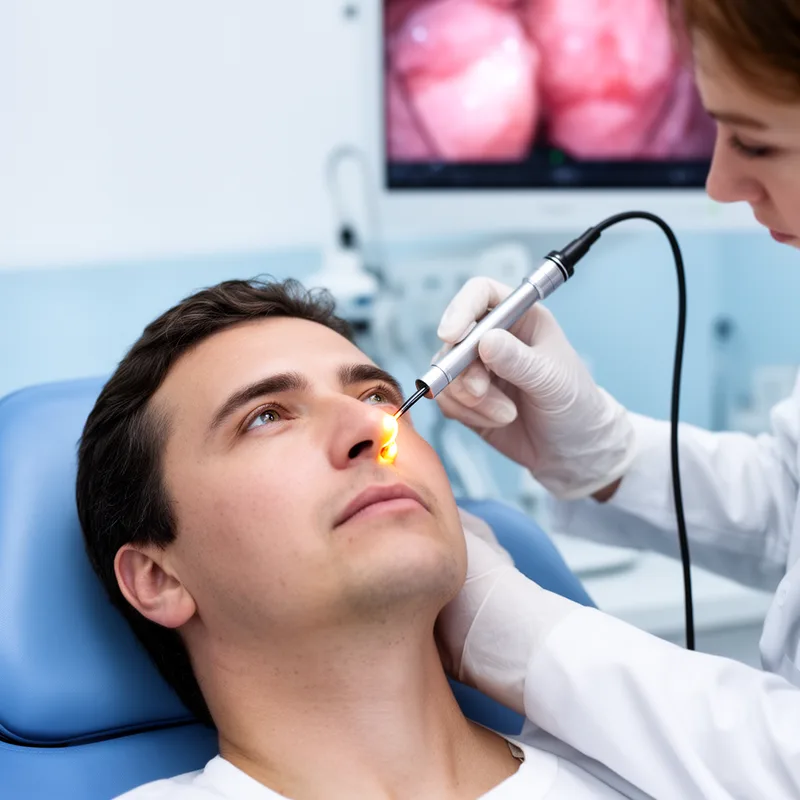
rhinoscopy
- noun
- /raɪˈnɒskəpi/
- Specialized
- Physical examination, including anterior rhinoscopy, revealed a normal external nasal appearance.
- anterior rhinoscopy
- rhinoscopy and endoscopy
- examination by rhinoscopy
Examples
-
Anterior rhinoscopy detected an anteriorly deviated nasal septum with a spur to the right; no mass was seen.
Academic text (2006) -
On examination, anterior rhinoscopy revealed that the septum was mildly deviated to the right.
Academic text (2010) -
Findings on posterior rhinoscopy were normal.
Academic text (2006) -
Rhinoscopy showed a polypoid lesion in the right middle meatus.
Academic text (2004) -
Anterior rhinoscopy and nasal endoscopy were performed on all patients before enrollment.
Academic text (2008) -
Thorough anterior rhinoscopy and endoscopy are accomplished in concert with the remainder of the otorhinolaryngologic examination.
Academic text (1994) -
Anterior rhinoscopy revealed the presence of a smooth bilateral septal bulge that completely obstructed the lumen of the nose.
Academic text (2002) -
On anterior rhinoscopy, he was found to have a hypervascularized and hypertrophied left middle turbinate and septal deviation.
Academic text (2008) -
Findings on anterior rhinoscopy, oral cavity examination, and flexible fiberoptic nasal endoscopy were normal in all 3 children.
Academic text (2004) -
The doctor used a rhinoscopy to check the patient's nasal passages for any abnormalities.
Surface Forms
Morphology
rhinoscopy = rhinoscope (opaque) = rhino + scopy
The elements are specialist combining forms (rhino- 'nose' and -scopy 'examination') that are not obvious to a B1 learner and do not align with the common meaning of 'rhino' as 'rhinoceros'.
Etymology
Rhinoscopy breaks into two parts: rhino- meaning 'nose' and -scopy meaning 'to look', like in microscope. So, rhinoscopy literally means 'looking into the nose', and it refers to the medical exam doctors use to look inside the nose.

