

rhinophyma
- noun
- /ˌraɪnəˈfaɪmə/
- Specialized
- Rhinophyma, the characteristic swelling of the nose, is a more common manifestation of rosacea in men.
Examples
-
Phymatous rosacea most often affects the nose (rhinophyma).
Academic text (2015) -
Hyperplasia of the connective tissue and sebaceous glands commonly affects the nose (rhinophyma) but also presents on the chin, forehead, ears, or eyelids.
Academic text (2015) -
When possible, avoid trigger factors. Be reassured that the condition can be successfully managed and that rhinophyma is very rare (particularly in women).
Academic text (2015) -
Case reports of unusual presentations have described signs that resembled alopecia, rhinophyma, and rosacea.
Academic text (2006) -
In low doses, it has been reported to be effective in the control of rosacea that was otherwise resistant to treatment and may help slow or halt the progression of rhinophyma.
Academic text (2015) -
A severe case of rhinophyma can lead to thickened skin and visible blood vessels, making the nose appear enlarged.
-
Many men develop rhinophyma due to untreated rosacea, resulting in a noticeable change in the shape of their noses.
-
Symptoms of rhinophyma include a marked enlargement of the nose, which is often painful and may require medical treatment.
Synonyms

A skin problem that makes the nose thick, red, and swollen with small red lines
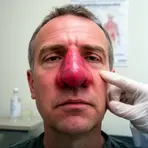
An enlarged red nose with visible blood vessels that often comes from heavy drinking

A large red round nose with small red lines from blood vessels

A red, swollen nose with small veins you can see after long heavy drinking

A red, swollen nose with small red veins, often linked to heavy drinking

A red, swollen nose with small broken veins, often from heavy drinking

A large red nose with visible small blood vessels often caused by heavy drinking

A nose that becomes large and red with visible veins from long heavy drinking
How Red


Surface Forms
Morphology
rhinophyma = phyma (opaque) = rhino + phyma
Formed from Greek combining elements ('rhino-' + '-phyma') that are not standalone English words and yield a technical medical term unfamiliar to average learners.
Etymology
Rhinophyma comes from Greek parts rhino- meaning 'nose' and -phyma meaning 'a swelling' or 'growth'. So, rhinophyma literally means a 'nose growth', which explains why it names the condition of an enlarged, thickened nose.