
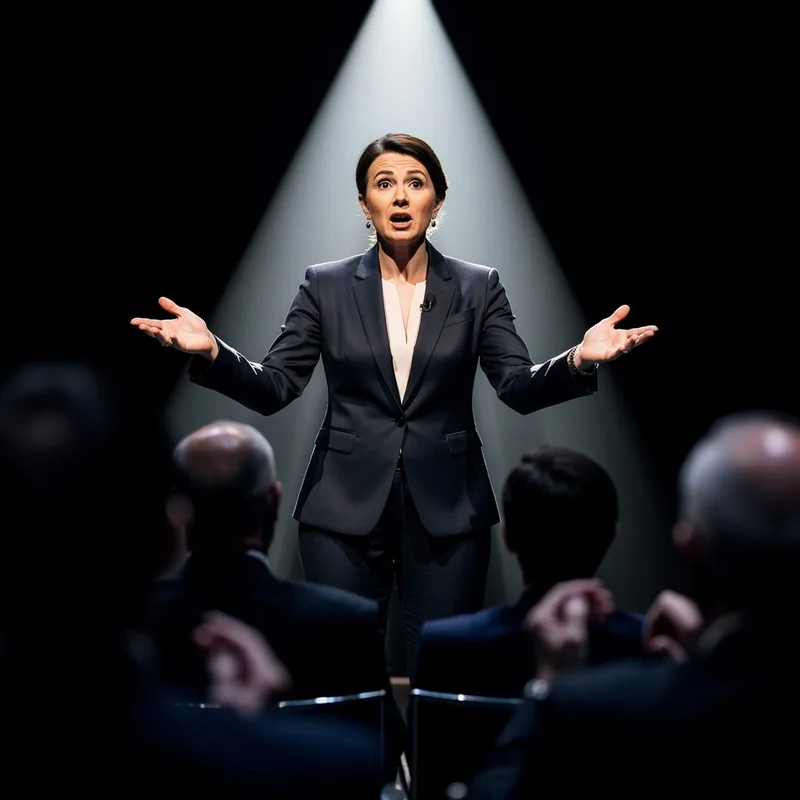
rhetorical question
 22
4.6
22
4.6

- noun
- /rɪˈtɔrɪkəl ˈkwɛsʧən/
- In his speech, he posed a rhetorical question to emphasize the importance of honesty.
- never answered rhetorical questions
- type of rhetorical question
Loading YouTube…
Watch on YouTubeSo, yeah, I mean, that's, that was just a rhetorical question.
- So, yeah, I mean, that's, that was just a rhetorical question.
- So it's, I asked myself this rhetorical question of what did I learn at USA?
Examples
-
When he asked, "Who doesn't want to be happy?" he intended it as a rhetorical question.
-
And again, this is a rhetorical question, so as not to cause any confusion.
Blog text (32) -
Is that a rhetorical question, or am I supposed to answer it?
-
That was a rhetorical question.
-
"Where am I supposed to get a thousand bucks?" It was a rhetorical question, and we both knew it.
Fiction book (1993) -
The effect of such a rhetorical question is highly persuasive.
Fiction book (1996) -
By inducing the audience to make the appropriate response, the rhetorical question can often be more effective as a persuasive device.
Academic text (1997) -
The audience did respond to my rhetorical questions and to other cues as I walked among the desks.
Academic text (2003) -
I'm assuming most of this is rhetorical questions with a liberal dose of snark.
Blog text (14) -
She rolled her eyes and said, "Isn't it obvious?" which was meant to be a rhetorical question.
Synonyms

A question asked to make people think, not to get an answer
How Rhetorical
22
4.6

- Jargon
7
5.2
Surface Forms
Morphology
The meaning is directly compositional: 'rhetorical' (aimed at persuasion or effect) modifies 'question' (a request for information), so a learner who knows both words can infer it is a question asked for effect rather than to elicit an answer. This is a straightforward adjective+noun composition found across languages, making the sense immediately derivable from the constituents.
Etymology
Rhetorical question comes from public speaking, where a speaker asked a question to make a strong point and did not expect anyone to answer. So a rhetorical question is asked 'to make a point', not 'to get an answer'.