

revolutions per minute
 1
3.5
1
3.5

- noun
- /ˌrɛvəˈluːʃənz pər ˈmɪnɪt/
- Specialized
- Ghodssi estimates that rotors supported by ball bearings could run at speeds between 10,000 to 200,000 revolutions per minute.
- revolutions per minute (RPM)
- 50 revolutions per minute
- 60 revolutions per minute
Examples
-
A high-performance composite flywheel rotor spinning anywhere from 30,000 to more than 100,000 revolutions per minute has lots of inertia.
Academic text (1996) -
Spinning at more than ten thousand revolutions per minute.
Fiction book (1996) -
Figure 1 (bottom panel) shows the revolutions per minute under control, music, money, and money plus music conditions.
Academic text (2007) -
The controller measures the revolutions per minute at the drive end and output and controls the gear shifting by changing its hydraulic pressure.
Academic text (1995) -
The encoder can operate in applications with rotation speeds of 30,000 revolutions per minute.
Academic text (2001) -
Participants pedaled at 60 revolutions per minute (rpm).
Academic text (2009) -
The lean burn stratified charge mode operates at engine speeds of up to 3,500 revolutions per minute, corresponding to urban driving conditions.
Academic text (2000) -
The motor turned the back roller at approximately 60 revolutions per minute (RPM), which translates into a roller surface speed of approximately 0.86 m/s.
Academic text (1995) -
The microcontroller is programmed to count the number of times the encoder disk rotates and reports the results in revolutions per minute (RPM).
Academic text (2008) -
The car's engine operates smoothly at 2,500 revolutions per minute on the highway.
Synonyms
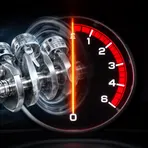 53
5.8
53
5.8
The number of times an engine turns in one minute
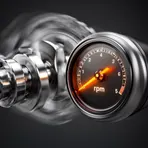 24
3.1
24
3.1
The number of complete turns a machine like an engine makes in one minute
How Fast


Surface Forms
Morphology
revolution + per + minute
The meaning 'number of complete rotations in one minute' is directly derivable from combining 'revolution' (one complete rotation) with 'per' (for each) and 'minute' (60 seconds). This X-per-Y measurement pattern is cross-linguistically common and follows standard compositional rules, so a B1 learner who knows the constituent words will readily understand the MWE.
Etymology
Revolutions per minute comes from the simple idea of counting how many revolutions, or full turns, a wheel or engine makes in one minute. So, it means 'how many full turns happen in one minute' and is used to show a machine's turning speed.