
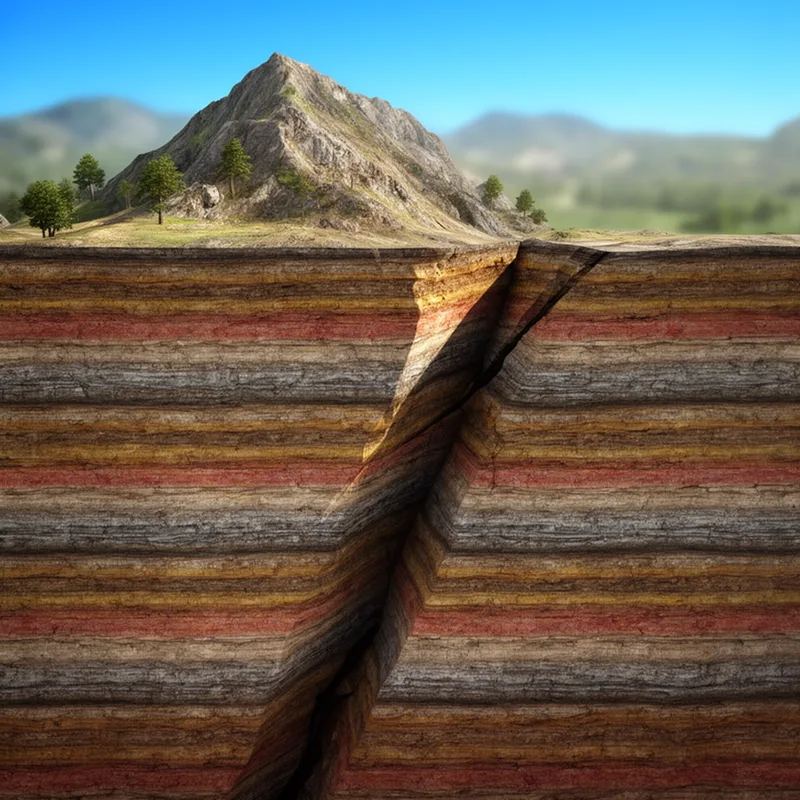
reverse fault
- noun
- /rɪˈvɜrs fɔlt/
- Specialized
 :
falla inversa
:
falla inversa
- This caused crustal fracturing that produced large thrust or reverse faults known as lobate scarps.
Examples
-
The reverse fault observed in the rock layers shows evidence of upward movement due to pressure from the Earth's crust.
-
Geologists identified a reverse fault during their study of the mountainous region, indicating significant compressional forces.
-
A normal fault, B forward fault, C reverse fault or D strike slip fault.
-
When two tectonic plates collide, they can create a reverse fault where one side is pushed upward.
Synonyms



 1
8.1
1
8.1
A break in rocks where the top part moves up over the lower part
 1
5.0
1
5.0
A crack in the Earth's crust where rock layers move

A break in rock where strong sideways force pushes one rock layer up and over another

A break in the ground where one side moves up at an angle
Surface Forms
Morphology
The term transparently combines 'reverse' and 'fault' so a learner who knows both words can infer it is a type of geological fault involving reversed or opposite movement (e.g., upward displacement). However, the precise technical detail—hanging wall moving up relative to the footwall due to compressional forces—is specialized geological knowledge and not fully predictable from the common meanings, so the expression is only partially transparent.
Etymology
The term reverse fault comes from a simple picture: when the Earth's crust is squeezed, one block is pushed up over the other. The word reverse shows the top block moves the 'opposite' way from a normal fault, so the name means a fault where one side is pushed up.