
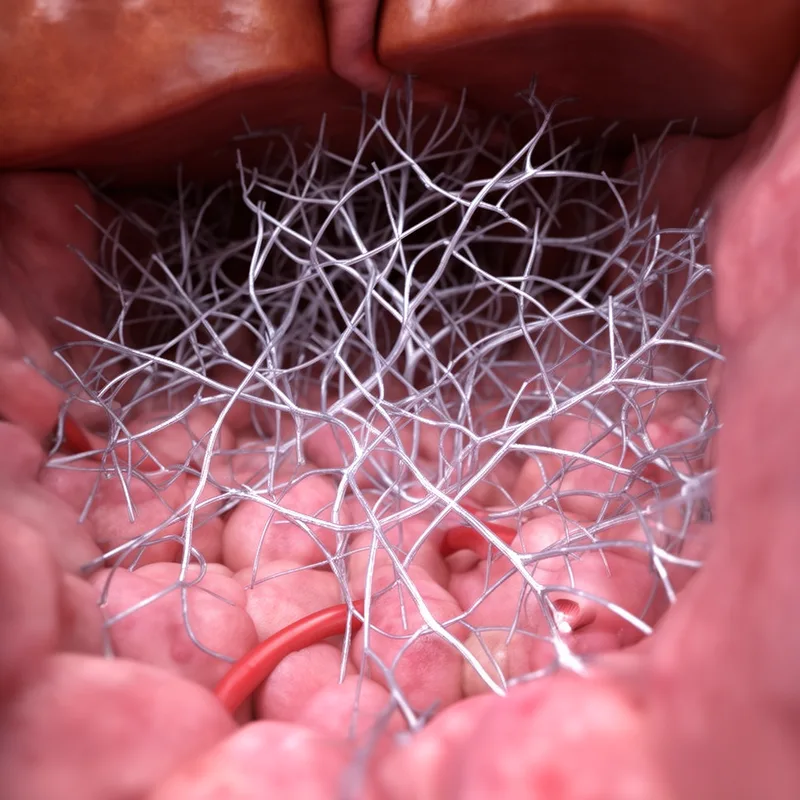
reticulin
- noun
- /rɪˈtɪkjʊlɪn/
- Specialized
- The collagen network was supported by reticulin, which helps provide strength and elasticity.
- reticulin antibody
- reticulin antibody positivity
- reticulin-antibody tests
Examples
-
In research, scientists examine the roles of reticulin in maintaining connective tissue structure.
-
Pathologists often assess reticulin levels to understand tissue integrity and disease states.
-
By contrast, reticulin-antibody tests have shown promise in identifying adults with coeliac disease.
Academic text (1991) -
Our study clearly shows that reticulin antibody positivity is associated with a genetic background similar to that in coeliac disease.
Academic text (1991) -
Serum reticulin-antibody positivity seems to be highly coeliac disease specific.
Academic text (1991) -
Reticulin-antibody positivity is an indicator of both silent and latent coeliac disease.
Academic text (1991) -
IgA reticulin and endomysium antibodies detected 92.3% of subjects with silent coeliac disease.
Academic text (1991) -
Reticulin or endomysium antibody positivity is an indicator of either silent or latent coeliac disease.
Academic text (1991) -
Instead of completing a small-bowel biopsy on most relatives, a serum reticulin IgA antibody test may be used to predict mucosal atrophy.
Academic text (1991)
Surface Forms
Morphology
reticulin = reticulum (semi-transparent) = reticul + in
Formed by adding the protein/substance-forming suffix '-in' to 'reticulum' (network); the relation is clear in scientific contexts but requires domain-specific knowledge, so not fully transparent for general learners.
Etymology
The word reticulin comes from the Latin reticulum meaning 'little net' and the ending -in shows it is a protein. So, reticulin is literally a protein that makes a small net of fibers, which is why it forms a fine network that supports tissue.

