
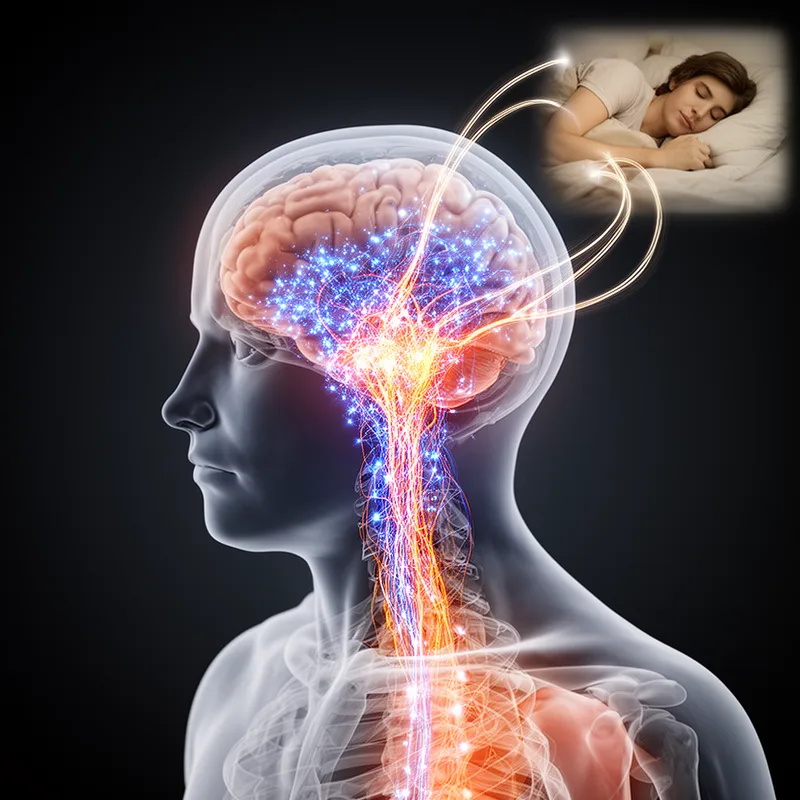
reticular formation
 1
8.7
1
8.7

- noun
- /rɪˈtɪkjələr fɔːrˈmeɪʃən/
- Specialized
- The reticular formation plays a crucial role in regulating sleep and wakefulness.
Examples
-
Scientists study the reticular formation to understand its impact on muscle tone and consciousness.
-
The immature reticular formation is particularly vulnerable to asphyxia.
Academic text (2002) -
What the reticular formation does, it modulates consciousness.
-
Some people say they get diffuse inputs and yet that reticular formation controls very specific functions.
-
When excited, the reticular formation activates the cortex.
Academic text (1998) -
If the reticular formation of the hypothalamus is not operating correctly, an individual may be erratic and unpredictable.
Academic text (1998) -
The reticular formation is an integral part of one's "limbic" system, which lies in the midforebrain near the top of the brain stem.
Academic text (1991) -
Lucia (1973) describes how the reticular formation, a structure in the brain stem, acts as a network of cells whose level of excitation rises or falls to modulate activity.
Academic text (1998) -
Additionally, the reticular formation enables learning and the recognition of environmental stimuli, which lead individuals to expect events and to plan action (Birren, Kinney, Schaie, and Woodruff 1981).
Academic text (1998) -
Damage to the reticular formation can lead to serious problems with attention and arousal.
Synonyms
 1
8.9
1
8.9
A network of nerve cells in the brainstem that helps control being awake, attention, sleep, and muscle tone
Surface Forms
Morphology
The components 'reticular' (netlike) and 'formation' (structure/formation) combine to give a literal sense of a netlike structure, so the basic idea is compositional. However, the expression is a technical anatomical term referring to a specific network of neurons in the brainstem with particular regulatory functions, which a B1 learner would not fully infer from the parts alone, making the overall meaning only partially predictable.
Etymology
Reticular formation: The term comes from Latin: reticular means a 'little net' and formation means 'structure'. Imagine a net of nerve cells in the middle part of the brain that filters signals to keep you 'awake', help you pay attention, and control muscle tone, so the name now means this brain network that does those jobs.