

to restate
 23
3.4
23
3.4

- verb
- /riːˈsteɪt/
 :
reformular
:
reformular
- Allow me to restate my position.
- restate the question
- restate an argument
- restate the main ideas
And I said, well, I'm going to restate this once we're back on.
- And I said, well, I'm going to restate this once we're back on.
- So I'm going to restate the Barber paradox as follows.
- So all of that said, I should restate a few things here.
- And I was like, let me restate this to you, real estate isn't scalable.
- Really Like like is, is that, let me restate that.
- All right, so let's, let's, let's, let's restate that.
- Given its extraordinary importance and implications for those who are dyslexic, I'm going to restate it here.
- So which so just to restate what you just said, you're saying in so many other professions there's a lot of money awaiting people who are all really good at it.
- And it was not difficult to show that the satisfiability problem can be restated as an integer programming problem.
- And she'll give me an out where she's restating my thesis a little bit wrong, but it would end the argument.
- OK, so let me just restate cache out the findings here.
- OK this is cool again, I will restate.
- Sorry, I should restate that even if it's overcast as close to waking as possible, get some sunlight in your eyes.
Examples
-
Restate the purpose of this visit.
-
Let me restate the question.
-
But before we move on, let me just restate this model, all right?
-
So again, I mean, let me maybe restate that more generally.
-
So all of that said, I should restate a few things here.
-
Let me restate that opening question for you to kick this off.
-
Given its extraordinary importance and implications for those who are dyslexic, I'm going to restate it here.
-
I'll restate the question.
-
The tutor provided feedback by restating the question and relevant propositions.
Academic text (2013) -
Let me restate the key points of our discussion to ensure everyone understands.
Synonyms
 ∞
1.0
∞
1.0
To do or say something again
 100
5.9
100
5.9
To say something again to make it clear
 89
1.6
89
1.6
Repeat what you just said so others can hear or understand
 64
4.1
64
4.1
To say the same thing using different words to make it clearer
 55
4.4
55
4.4
To say again clearly that something is still true or important
 42
3.7
42
3.7
To say something again in different words to make it clearer
 22
5.1
22
5.1
To say something again more strongly
 11
2.8
11
2.8
To tell a story or event again in different words
 4
3.4
4
3.4
Change the words of a sentence to say the same thing more clearly
 3
4.4
3
4.4
To say again that something is important
 2
8.0
2
8.0
To briefly repeat the main points
 2
6.3
2
6.3
To say something again so people understand


 1
6.7
1
6.7
To say something again in a clearer way

To state something again more clearly

Say something again in a clearer way

To write a sentence again using different words
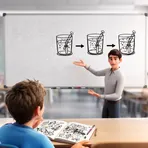
To describe something again in a different way to make it clearer

Say something again in different words

To say something again to show it is important
How Emphatic

Surface Forms
Morphology
Etymology
Restate breaks into re- meaning 'again' and state meaning 'to say', like in statement. So, to restate is to 'say again', often in a clearer or different way to make people understand.