
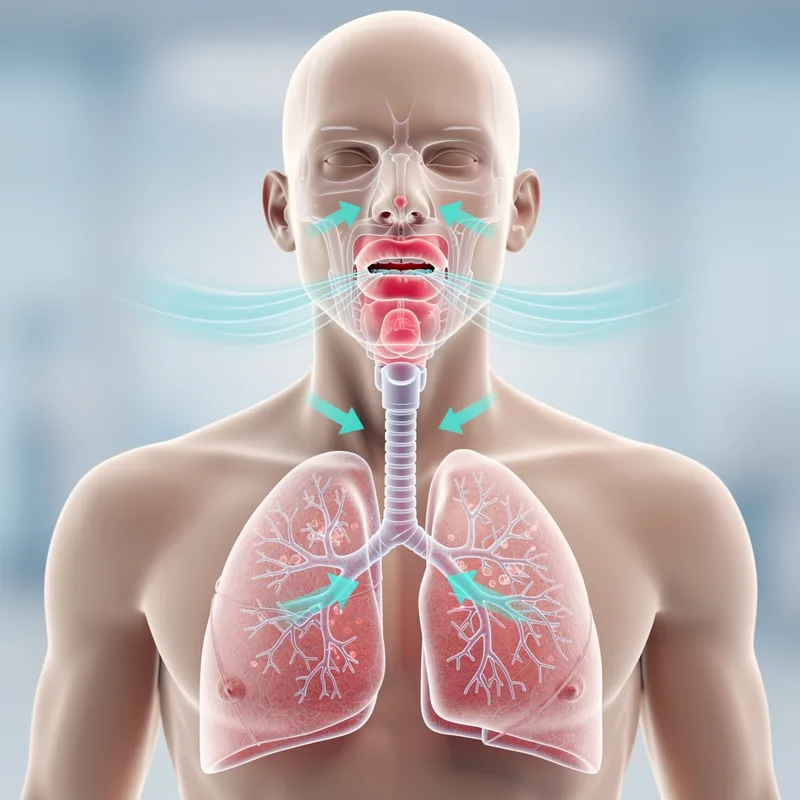
respiratory tract
 3
3.4
3
3.4

- noun
- /ˈrɛspəˌrɛtəri træk/
- Specialized
- Influenza is a common virus that affects the respiratory tract and causes symptoms like coughing and fever.
- respiratory tract infection
- upper respiratory tract
- lower respiratory tract
Loading YouTube…
Watch on YouTubeIf you have some minor infectious thing in your upper respiratory tract that you've only had for one or two or three days, give it time to run its course.
- If you have some minor infectious thing in your upper respiratory tract that you've only had for one or two or three days, give it time to run its course.
Examples
-
The doctor explained that allergies can irritate the respiratory tract, leading to breathing difficulties.
-
Blastomycosis is a chronic fungal disease that primarily affects the lower respiratory tract.
Academic text (2002) -
Every year, the average adult in the United States contracts two to three upper respiratory tract infections.
Academic text (1995) -
These receptors are found in the cells of both the respiratory tract... and the central nervous system.
-
Biofilms no doubt play a role in most chronic respiratory tract diseases.
Academic text (2003) -
If you have some minor infectious thing in your upper respiratory tract that you've only had for one or two or three days, give it time to run its course.
-
708 children admitted with acute lower respiratory tract symptoms underwent review by a research nurse.
Academic text (2003) -
Streptococcal pharyngitis is a frequent cause of bacterial infections of the upper respiratory tract.
Academic text (1995) -
Short-term voice problems are commonly associated with respiratory tract infections such as coughs, colds, and influenza.
Academic text (2011) -
Airborne allergens typically target the respiratory tract and eyes, causing rhinitis, asthma, and conjunctivitis.
Academic text (1998)
Synonyms
 65
2.9
65
2.9
A passage in the body that carries air to and from the lungs
How Extensive
- Specialized
3
3.4

- Specialized
14
4.6
- Specialized
1
7.9
- Specialized
4
4.2
72
1.0
Surface Forms
Morphology
The phrase is a straightforward adjective + noun composition: 'respiratory' (pertaining to breathing) modifies 'tract' (a bodily passage/system), so the combined meaning — passages involved in respiration — is directly derivable from the parts. This construction is cross-linguistically common and follows standard medical/biological naming patterns, so a learner who knows both constituents can infer the MWE's meaning.
Etymology
Respiratory tract comes from the words respiratory, from the verb 'respire' meaning 'to breathe', and tract, meaning 'a path' or 'area'. Think of it as the path or set of passages that air travels through in the nose, throat and lungs, so the name explains why it means the parts of the body that let you breathe.