
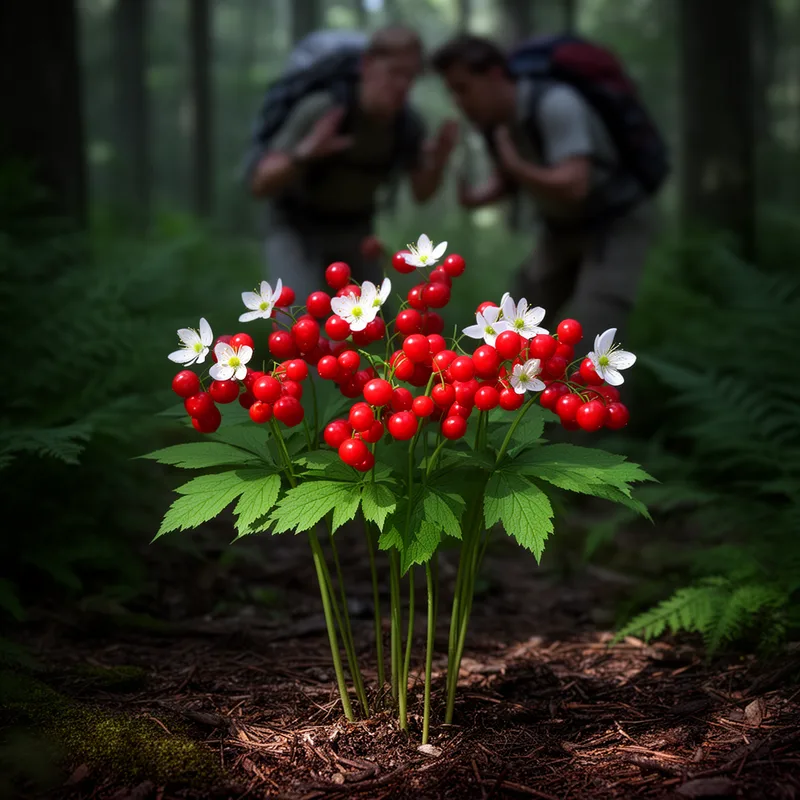
red baneberry
- noun
- /rɛd ˈbeɪnˌbɛri/
- Specialized
- The red baneberry is toxic to humans.
Examples
-
Many hikers avoid touching the red baneberry because its berries are highly poisonous.
-
In the shaded forest, clusters of red baneberry stood out among the greenery.
-
Children must be taught to recognize red baneberry and not to eat its tempting fruit.
-
Many birds enjoy the berries of the red baneberry.
-
The garden was filled with beautiful red baneberry plants, showcasing their bright red berries.
-
When hiking in the woods, I carefully avoided the red baneberry, knowing it could be toxic.
-
The red baneberry is easily identifiable by its clusters of white flowers and striking red berries.
Synonyms

A North American plant that lives for many years with divided leaves, small white flowers, and bright red poisonous berries

A small woodland plant with white flowers and bright red poisonous berries

A plant that grows in woods with clusters of small poisonous berries
Surface Forms
Morphology
This is a straightforward color + noun compound: 'red' simply describes the color of the 'baneberry'. If a learner knows 'red' and 'baneberry' (a poisonous berry), they can infer the phrase denotes a baneberry that is red; the modifier + noun composition is cross-linguistically common and fully compositional.
Etymology
Red baneberry comes from the old word bane meaning 'poison' and berry meaning the fruit; its bright red berries look tempting but are poisonous, so the name warns you not to eat them.

