
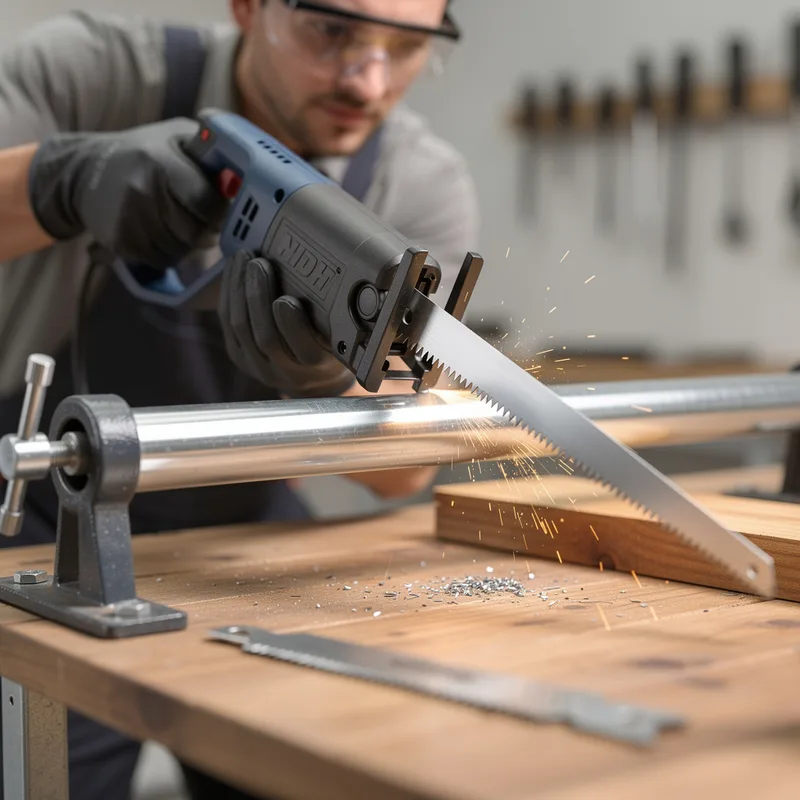
reciprocating saw
 1
5.1
1
5.1

- noun
- /rɪˈsɪprəˌkeɪtɪŋ sɔ/
- Specialized
- So I used a reciprocating saw that had a blade that cuts through both wood and nails at the same time to take apart the pallets.
- reciprocating saw blade
- used a reciprocating saw
- reciprocating saw to cut
Examples
-
A reciprocating saw is ideal for cutting through thick branches in the garden.
-
In my barn, we have a table saw, a circular saw, a miter saw, a scroll saw, a jig saw, a planer, a reciprocating saw, sanders in every shape and size, a band saw, and more drills than you can shake a stick at.
Blog text (2) -
So you might have seen our last attempt at making a heat sink, where we took a reciprocating saw to a block of aluminum with
-
Well I'm using a reciprocating saw on these two by fours but it does...
-
I think Proxon makes a little handheld reciprocating saw, but this is my this is my jam.
-
I'm using a reciprocating saw on these two-by-fours, it doesn't seem to work.
-
Reciprocating saws work great, though they may be a little noisy.
Blog text (8) -
Using a reciprocating saw, osteotomy of the outer table of the frontal bone and superior orbital rim was performed as close as possible to the lateral sinus margins.
Academic text (2005) -
To remodel the kitchen, I used a reciprocating saw to remove the old cabinets.
-
For my DIY project, I borrowed a reciprocating saw to easily cut the wooden beams.
Synonyms
 54
1.0
54
1.0
A tool with a thin toothed blade used to cut wood or other materials
 3
3.2
3
3.2
A machine with a blade that has teeth and cuts wood or other materials
 3
4.9
3
4.9
A small electric saw with a thin blade for cutting curves and detailed shapes in wood
 1
6.7
1
6.7
A handheld power tool that cuts wood and other materials with a blade that moves back and forth
A handheld saw with a blade that moves back and forth to cut wood or metal
How Powerful
75
3.5
 5
3.5
5
3.5
- Specialized
1
5.1
- Specialized
3
4.9
14
4.0
Surface Forms
Morphology
The compound is fully compositional: 'reciprocate' (move alternately/back and forth) + 'saw' (cutting tool) yields a tool whose blade moves back-and-forth. This descriptive noun formation is regular and cross-linguistically common, so a B1 learner who knows both constituents can infer the meaning.
Etymology
The noun reciprocating saw is named for how its blade works: reciprocating means 'moving back and forth' and saw is the cutting tool, so picture a blade that pushes forward and pulls back to cut. That's why the tool is used for fast, rough cuts and why you can change blades to cut wood, metal, or plastic.