
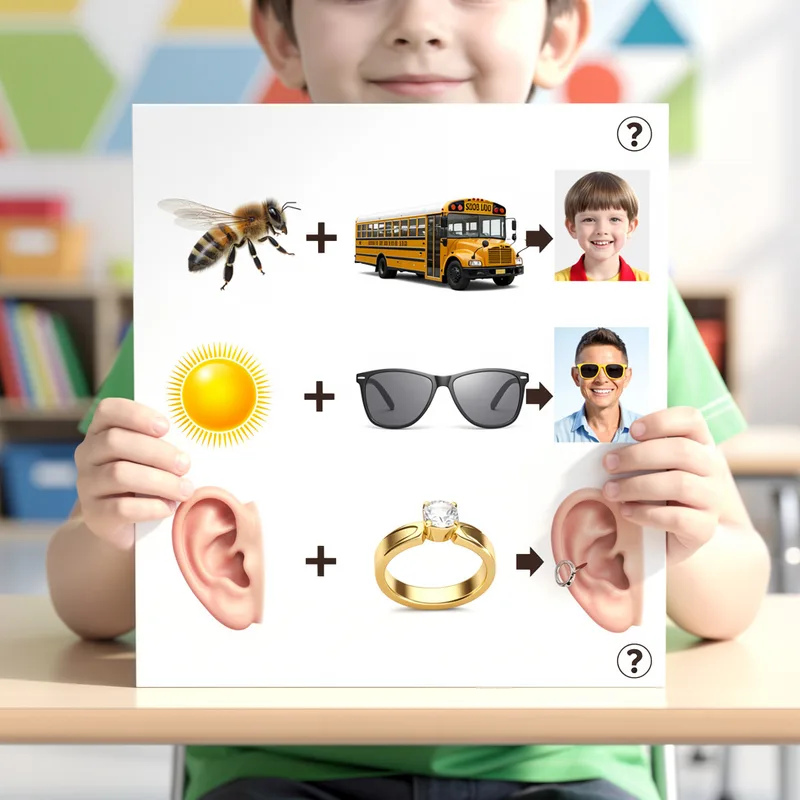
rebus
 2
9.4

- noun
- /ˈriːbəs/
- The teacher used a rebus to help the students understand the concept of homophones.
- rebus-like
Examples
-
So most ancient scripts use the Rebus principle, which is using pictures to represent words.
-
In art class, we created a rebus using pictures to show a well-known saying.
-
- I remember seeing this rebus decoder online.
-
- Oh, rebus is like a coded message that uses the images and letters and numbers instead of words.
-
None of the teachers surveyed were familiar with the rebus approach.
Academic text (1991) -
The kids solved the rebus puzzle that combined images and letters to reveal a fun phrase.
Synonyms
 474
1.9
A game or problem that tests how well you think
 5
6.7
A difficult question or problem for people to solve
 4
6.5
A hard puzzle that needs careful thought to solve
 2
7.8
A poem or puzzle where the first letters of each line spell a word
 2
5.1
A difficult puzzle that needs careful thinking to solve


 1
6.4
A square puzzle where the same words read across and down
 1
6.3
Something that makes you think hard about a topic
Surface Forms
Etymology
Rebus comes from a Latin phrase meaning 'by things' and from the root res, which means 'thing'. A helpful way to remember it is that a rebus is a puzzle that uses pictures or objects to stand for words, so it spells a message 'by things' instead of by letters.