

raffia palm
- noun
- /ˈræfiə pɑːm/
- Specialized
- Craftsmen in Madagascar skillfully use the strong fibers from the raffia palm for various handmade goods.
Examples
-
The stamp was usually of bamboo rather than raffia palm (thus eliminating the need to carve a circle), although one artist used raffia palm for a large circle.
Academic text (2007) -
The weavers harvested long fibers from the raffia palm to create beautiful baskets.
-
Motifs were cut into the soft core of raffia palm with a knife, although bamboo was employed for the circle motif.
Academic text (2007) -
The stamp was usually of bamboo rather than raffia palm (thus eliminating the need to carve a circle), although one artist used raffia palm for a large circle.
Academic text (2007) -
Kike (Fig. 4) are carved and pegged figurines made from the pith of the raffia palm (often called bamboo in the literature).
Academic text (1994) -
In the 1960s, it was still the practice for an effigy of the deceased made of raffia palm branches and cloth to be deposited at Igbo Iwale, even though the corpse had previously been interred within the home compound.
Academic text (1994) -
The artist chose raffia palm for its durability and flexibility while making intricate decorations.
Synonyms

A large palm tree from Africa and Madagascar whose long leaves give strong fibers used to make ropes and mats

A large palm native to Africa and Madagascar with long divided leaves that gives strong fibers for weaving

A tall tropical palm tree with strong fibrous leaves grown for weaving
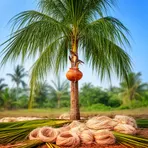
A tall tropical palm whose long leaves produce strong fibers and palm wine
Surface Forms
Morphology
The phrase names a type of palm and its meaning is directly derivable from combining 'raffia' (a palm grown for strong fibrous leaves) with 'palm' (a tropical tree). This follows a common noun+noun naming pattern for plant species, so a B1 learner who knows both constituents should be able to infer the MWE's meaning.
Etymology
Raffia palm gets its name from the long leaf fibers called 'raffia' that people use to weave baskets and make rope. The word palm points to the tree that gives these strong 'fibers', so the name reminds us that this tree is useful for making things from its leaves.

