
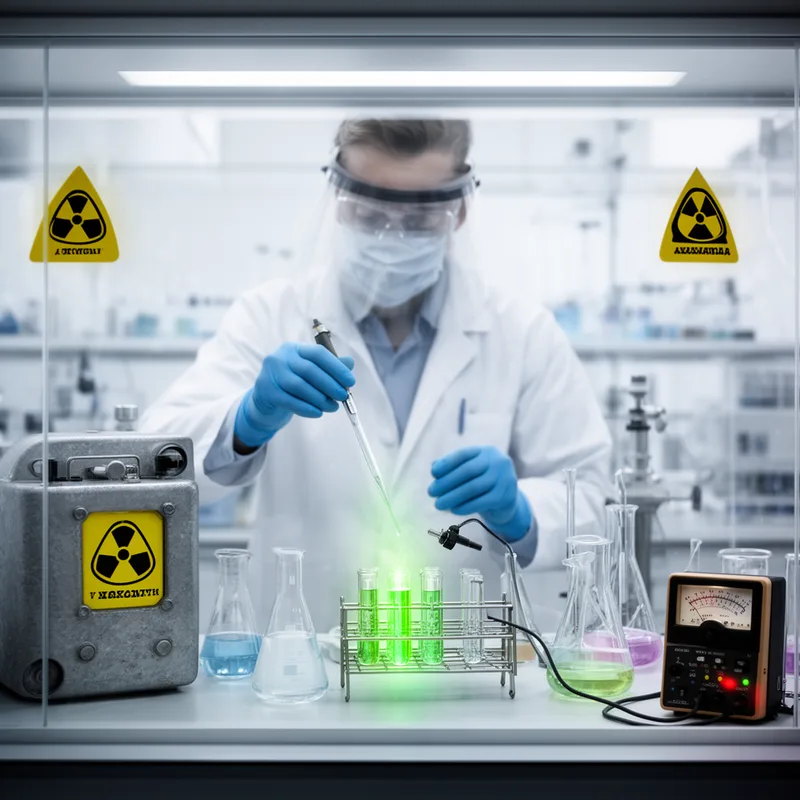
radiochemistry
- noun
- /ˌreɪdiəʊˈkɛmɪstri/
- Specialized
- Advances in radiochemistry have improved our understanding of the behavior of nuclear waste.
- radiochemistry laboratory
Examples
-
On 22 December 1948, the radiochemistry plant received its first irradiated fuel rods, from which 100 mg of Pu were extracted.
Academic text (1996) -
Reprocessing of fuel rods started on 22 December 1948, when the first irradiated product was delivered from the reactor to the radiochemistry laboratory.
Academic text (1996) -
Weapons inspectors rely on instruments and techniques similar to those used for low-level radiochemistry measurements at nuclear power plants.
Academic text (2004) -
The complex was to have three components: the "A" plutonium-production reactor, the "B" radiochemistry (reprocessing) laboratory, and the "V" metallurgical (fabrication) laboratory.
Academic text (1996) -
Researchers in radiochemistry study how radioactive materials interact with various chemicals.
-
The university offers a course in radiochemistry that covers the properties of radioactive isotopes.
Synonyms

The study of radioactive materials and reactions in atomic nuclei
Surface Forms
Morphology
Etymology
Radiochemistry comes from radio- meaning 'ray' and chemistry meaning 'the study of substances'. Think of radiate or radiation, which mean 'to send out rays', so radiochemistry is the part of chemistry that studies substances that send out rays, or radioactive materials.

