
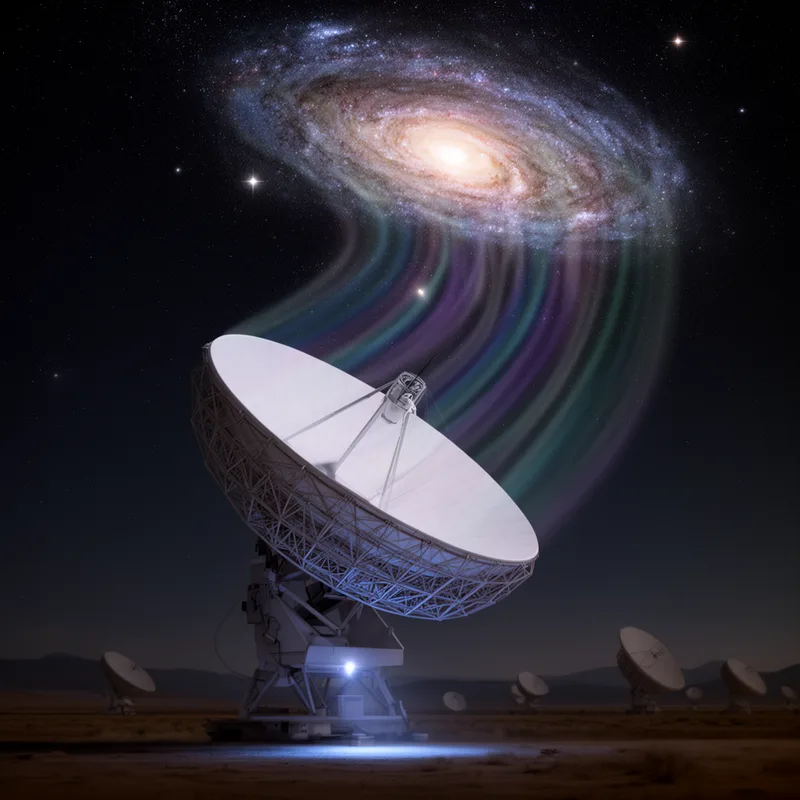
radio astronomy
 2
4.2
2
4.2

- noun
- /ˈreɪdioʊ əˈstrɒnəmi/
- Specialized
- He's head of the radio astronomy section of the National Science Foundation.
- a new branch of radio astronomy
Examples
-
In the years after World War II, radio astronomy grew apace.
Academic text (1991) -
With the advent of radio astronomy, new ways became available for looking at this problem of star-forming regions.
Academic text (1993) -
World War II brought radar into wide use, with important consequences for radio astronomy.
Academic text (1991) -
It's clear, then, from basic chemistry and radio astronomy, that the basic materials for life are out there.
Blog text (6) -
I was first introduced to radio astronomy in my university astronomy classes.
Academic text (2004) -
Interferometry has long been the dominant technique of radio astronomy.
Academic text (2000) -
Hulse actually left the field of radio astronomy a few years after his momentous find.
Academic text (2001) -
However, the long-term success of the NRAO and radio astronomy in general will depend upon the next generation of radio astronomers.
Academic text (2005) -
Cline notes that radio astronomy research has been heavily concentrated at the National Radio Astronomy Observatory (NRAO).
Academic text (2005) -
Research in radio astronomy has revealed the presence of black holes in distant galaxies.
How Specialized
- Specialized
2
4.2

- Specialized
- Specialized
8
4.4
Surface Forms
Morphology
radio + astronomy
The meaning is directly compositional: 'radio' (radio waves/signals) plus 'astronomy' (the study of celestial objects) yields the study of celestial objects using radio waves. This pattern is transparent and cross-linguistically regular (e.g., Spanish radioastronomía), so a B1 learner who knows both constituents can readily infer the meaning.
Etymology
Radio astronomy combines radio and astronomy: it pictures scientists using radio equipment to 'listen' to the sky instead of just looking. That's why it means studying the radio waves that come from space.