

radial nerve


 1
6.6
1
6.6
- noun
- /ˈreɪdiəl nɜrv/
- Specialized
- The superficial radial nerve branches were identified and protected throughout the surgery.
- ulnar and radial nerve
Examples
-
When a spiral or oblique fracture damages the radial nerve.
Academic text (2003) -
In a study involving 39 patients with a scapular fracture, McGinnis and Denton (11) noticed that one of their patients had an associated radial nerve injury.
Academic text (2015) -
The patient is asked to perform a "thumbs up" sign to confirm radial nerve function.
Academic text (2006) -
In addition, a thorough neurovascular exam should be done to assess for injuries to the median, ulnar, or radial nerve.
Academic text (2006) -
Therefore, if a brachial plexus injury is suspected, special attention should be devoted to radial nerve and ulnar nerve deficits because they account for nearly 75% of main branch lesions.
Academic text (2015) -
The doctor checked the radial nerve to ensure it was functioning properly after the injury.
-
During the assessment, they tested the radial nerve to see if the patient could extend their wrist.
-
To determine the cause of the weakness, the surgeon examined the radial nerve for any signs of damage.
Synonyms
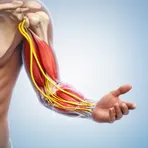
A large nerve in the upper arm that makes the wrist and fingers straighten
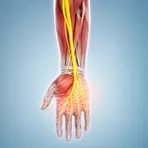
A large arm nerve that controls feeling on the back of the hand and muscles to straighten wrist and fingers
Surface Forms
Morphology
The compound is directly compositional: 'radial' (pertaining to the radius/side of the forearm) modifies 'nerve' (a bundle of nerve fibres), so the phrase denotes the nerve associated with the radius/outer side of the arm. This is a straightforward anatomical modifier+noun formation found cross-linguistically, so a learner who knows the constituent meanings can infer the MWE meaning.
Etymology
Radial nerve comes from the bone radius in the forearm, because the nerve runs along that bone like a line from the elbow to the wrist. That's why it means the nerve that goes down the arm and 'helps move' and 'feel' the back of the hand.