
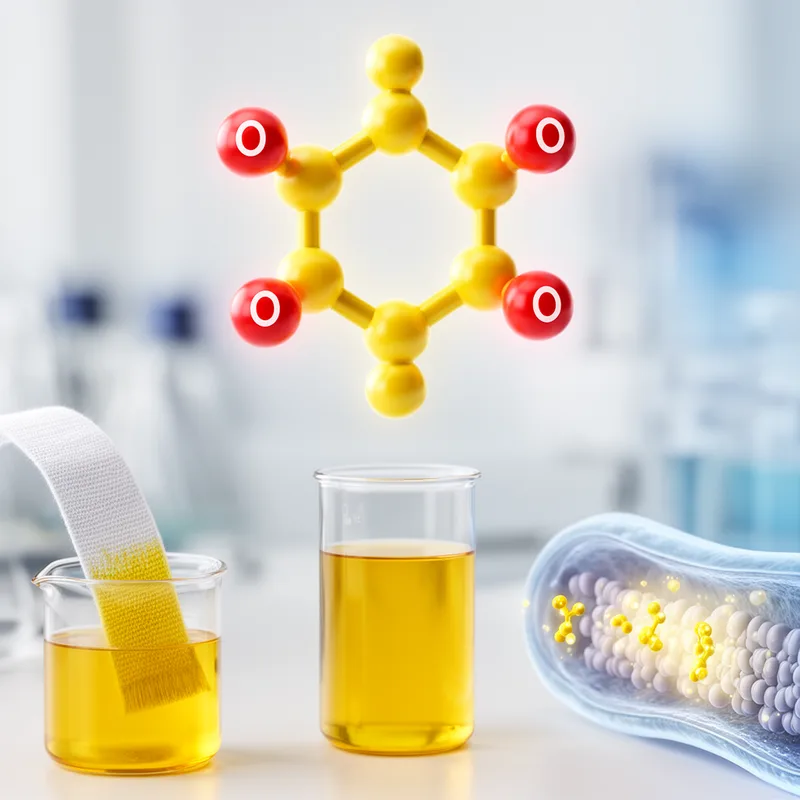
quinone


 1
9.6
1
9.6
- noun
- /ˈkwɪnoʊn/
- Specialized
- Vitamin K is a type of quinone that plays a crucial role in blood clotting.
Examples
-
Many quinones are used in dye production.
-
Many bacteria use quinone molecules as electron carriers in their respiratory chains.
-
The synthesis of quinone is an essential step in the production of certain dyes.
-
The chemist synthesized quinone for his experiments.
-
The study focused on how quinones act as essential coenzymes in various biological processes.
-
Researchers discovered that quinones can be used to create a vibrant yellow dye for textiles.
-
In plants, oxidized quinones play a crucial role in energy storage and transfer during photosynthesis.
Synonyms

A yellow chemical used in dyes that accepts electrons in living things
A molecule in cells that helps make energy by transferring electrons

A yellow chemical that people use in dyes and sometimes as a mild laxative
Surface Forms
Morphology
quinone = quin + one
Formed from a specialized chemical combining form ('quin-') plus the chemical suffix '-one'; the root 'quin' is not a standalone English word and the compound meaning is technical, so an average B1 learner cannot derive the meaning from its parts.
Etymology
The word quinone comes from the parts quin- and -one, where -one is a chemical ending meaning 'a ketone', just like in acetone. So, quinone names a group of yellow organic molecules that have ketone parts and are used in dyes and in biology.