
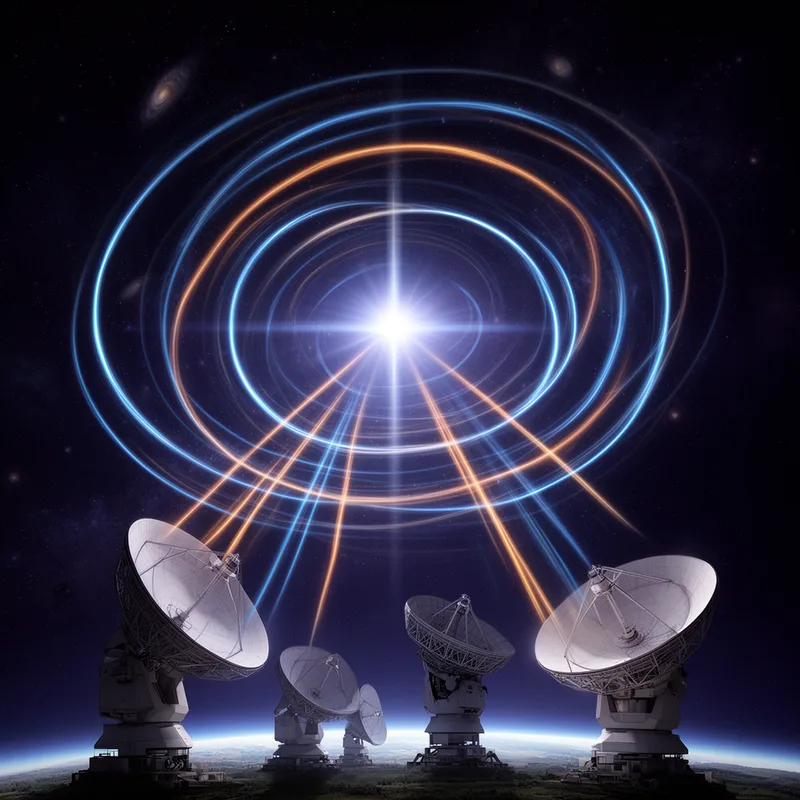
quasi-stellar radio source
- noun
- /ˈkwɑːziˈstɛlər ˈreɪdioʊ sɔrs/
- Archaic
- The name quasar, shorthand for "quasi-stellar radio source," implies the uncertainty about their nature.
Examples
-
The discovery of quasi-stellar radio sources has changed our understanding of the universe's structure.
-
Quasars, also known as quasi-stellar radio sources, are found billions of light-years away from Earth.
-
Scientists study quasi-stellar radio sources to learn more about the early stages of galaxy formation.
Synonyms
 13
9.9
13
9.9

A very bright object in space, like a star, powered by a black hole
 1
6.7
1
6.7
An object in space that sends out radio waves we can detect
How Radio-Loud
- Specialized
3
9.9

- Archaic
Surface Forms
Morphology
quasi-stellar + radio + source
The phrase is compositionally built: 'quasi-stellar' means 'star-like' or 'resembling a star', 'radio' refers to radio (electromagnetic) waves, and 'source' means origin. Put together a learner who knows these constituents can infer it denotes a star-like object that emits radio waves (i.e., a quasar), so the meaning is directly derivable from the parts.
Etymology
The name quasi-stellar radio source comes from early space research. Scientists saw tiny bright points that looked like stars but sent out very strong radio waves. The parts quasi-stellar ('almost a star') and radio source ('thing that makes radio waves') give a clear picture: a star-like object that made powerful radio signals, and this object later became known as 'quasar'.