
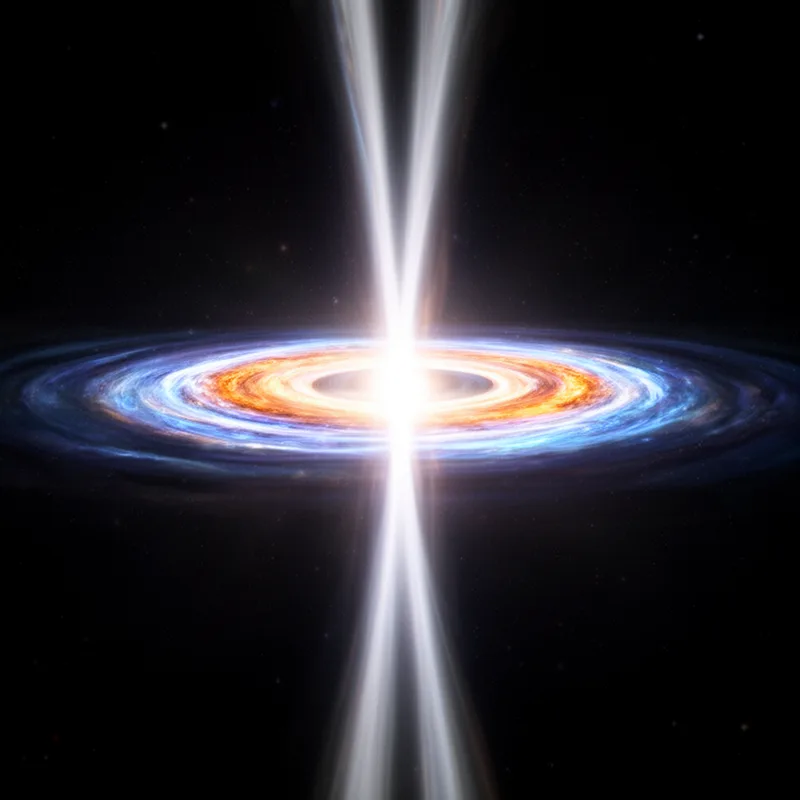
quasar
 13
9.9
13
9.9

- noun
- /ˈkwāˌzär/
- Specialized
- X-ray astronomy, which is now able to study distant stars, galaxies, and quasars, began with studies of the Sun.
- quasars and galaxies
- a distant quasar
- quasar redshifts
Loading YouTube…
Watch on YouTubeWe detect quasars with radio telescopes and radio antenna.
- We detect quasars with radio telescopes and radio antenna.
- A quasar and quasars are are part of a zoo of objects which we call active galaxies, Active galaxies, inactive galaxies.
- Then there's the huge Quasar Group, which is huge.
- A world devoted to the mysteries of the universe, like quasars, corks, and most baffling of all, Qdoba.
- And I think the little buff SpongeBob representation there is all I'm going to think of now when I think about quasars.
Examples
-
In these frames, light from a quasar or radio galaxy is distorted by the gravity of an intervening galaxy.
Academic text (1995) -
Another group has been studying quasar spectra from Hubble's Faint Object Spectrograph.
Academic text (1995) -
Consider a typical quasar spectrum, as shown on page 25.
Academic text (1999) -
At the top spectrum is a normal quasar spectrum.
-
The big spike on the right is the Lyman-alpha emission line from the quasar.
Academic text (1999) -
According to the newsman, the astronauts are pointing a giant telescope at a quasar fifteen billion light-years away.
Fiction book (1997) -
Seyfert galaxies and quasars with intensely active nuclei were found to be even brighter in X-rays.
Academic text (1991) -
Astronomers have discovered a powerful quasar that emits more energy than entire galaxies.
-
The light from the distant quasar takes millions of years to reach Earth, revealing the early universe.
-
Scientists study quasars to understand the behavior of supermassive black holes at the centers of galaxies.
Synonyms
A bright object far away in space that looks like a star and sends strong radio waves
How Bright

Surface Forms
Etymology
Quasar comes from the phrase quasi-stellar radio source; quasi means 'as if' or 'almost' and stellar means 'star'. So a quasar is an 'almost star': it looks like a star but is actually a very bright, very distant object powered by a huge black hole, which is why astronomers used that name.