
pulsar
 22
8.9

- noun
- /ˈpʌlsɑr/
- Specialized
- Astronomers detected a faint signal from a distant pulsar, which could help us understand the universe's evolution.
- millisecond pulsar
- binary pulsar
- radio pulsar
Loading YouTube…
Watch on YouTubeIf those neutron star emit flashes of X-rays, these are pulsars and you can measure the rotation of neutron stars.
- If those neutron star emit flashes of X-rays, these are pulsars and you can measure the rotation of neutron stars.
- And so if you detect a change in the arrival time of those pulses, then you know that something has affected the pulsar, perhaps making it wobble around.
- Oh, so one thing that pulsars are trying to be used for is to detect gravitational waves.
- And then when there's been stuff like this in the past as a pulsar, a boring, stupid pulsar.
- It would make it a huge outlier for neutron stars and pulsars.
- So now near the binary pulsar.
- Although even some of these more exotic things do have planets like pulsars, which are planets, sorry, which are stars that are old and very dense.
Examples
-
The pulsar was observed to be rotating at an incredible speed, making it a subject of intense study.
-
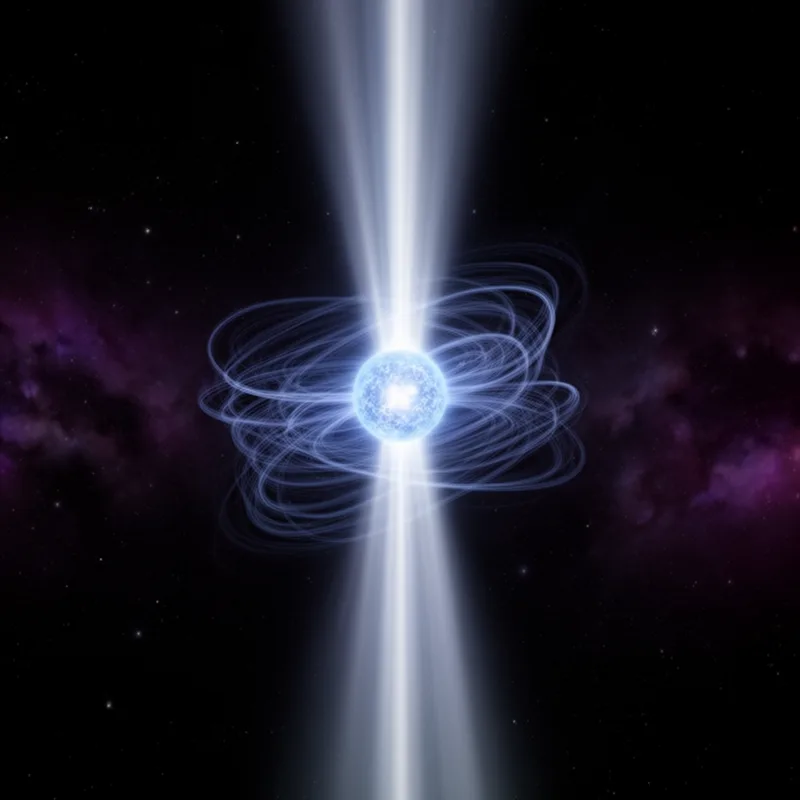
Appearing as highly regular pulsed point sources, pulsars are spinning, city-sized neutron stars left behind by supernovae.
Academic text (2012) -
In these systems, the pulsar and a relatively ordinary star orbit around each other.
Academic text (1991) -
Oh, so one thing that pulsars are trying to be used for is to detect gravitational waves.
-
A binary pulsar is rotating around and doing some complicated emission of gravitational waves close by.
-
Radio astronomers have been eager to find more fast pulsars because of their accurate timing properties.
Academic text (2012) -
Rotating neutron stars called pulsars emit radio waves at regular intervals, similar to a lighthouse beacon.
Academic text (1990) -
Scientists have discovered a new pulsar that emits regular radio waves every 1.5 seconds.
Surface Forms
Morphology
Etymology
The word pulsar comes from the phrase pulsating star and the familiar word pulse ('a regular beat'). That's because these stars send out very steady flashes, like a fast, cosmic heartbeat, so a pulsar is a star that gives regular pulses of radio and other waves.