

to pull at
 12
3.9
12
3.9

- phrasal verb
- /pʊl æt/
- So first step is gently pull at the edges, right?
- pulling at my clothes
- pulled at her sleeve
- pull at her hair
Loading YouTube…
Watch on YouTubeSo first step is gently pull at the edges, right?
- So first step is gently pull at the edges, right?
- When Alder came closer and looked, he saw the child was prying and pulling at the stones, trying to loosen one, then another.
Examples
-
Pitt shifted uncomfortably, instinctively pulling at his collar to ease it from choking him.
Fiction book (1993) -
Then you can pull out the cable that's in there, but don't pull at the wire.
-
I, I tried to pull at the door, but, uh...
-
Will you stop pulling at the skin on your toe?
-
"Are you all right?" Brianna, obviously upset, pulled at her mother's arm.
Fiction book (1992) -
That's because you've been pulling at it for two hours.
-
My two younger brothers grow restive and pull at me to climb up on a ladder-back chair.
Fiction book (1990) -
Stronger and stronger, it pulled at him, peeling his bleeding fingers from the wall to which he clung.
Fiction book (1990) -
The mare wasn't anxious to approach the church, nodding her head nervously and pulling at the reins.
Fiction book (1990) -
"What are you doing?" she asked, noticing him pull at the loose string on his sweater.
Synonyms
 77
3.5
77
3.5
To pull something out quickly with the fingers
 56
1.0
56
1.0
To pull something hard, often in a quick way
 32
3.9
32
3.9
To touch or move something nervously without thinking
 5
3.8
5
3.8
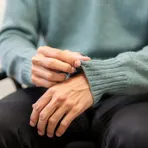
Pull at something with your fingers again and again, often nervously
 3
6.1
3
6.1
To pull lightly and repeatedly at something with your fingers
Antonyms

How Hard

Surface Forms
Morphology
pull + at
The basic idea—using 'pull' (to exert force) plus 'at' (marking the target of the action)—makes the notion of tugging at something fairly predictable for a learner who knows both words. However, the specific sense of light, repeated tugs as a nervous or habitual action (pluck/repeatedly tug) is a pragmatic/behavioral extension not fully deducible from the parts, so the expression is only partially transparent.
Etymology
Pull at comes from the simple picture of someone using their fingers to pull at a sleeve, loose thread, or a bit of hair again and again. That small, repeated tugging became a sign of being 'nervous' or 'distracted', so pull at now means 'to tug or pluck lightly and repeatedly', often because of nerves.