

public transport
 39
1.4
39
1.4

- noun
- /ˈpʌblɪk ˈtrænspɔrt/
- UK
- Many people rely on public transport to commute to work each day.
- use public transport
- access to public transport
- public transport system
Loading YouTube…
Watch on YouTubeI just use my bike and public transport and trains.
- I just use my bike and public transport and trains.
- He, he couldn't go onto public transport anymore.
- So so he has the public transport really for free.
- You're the one that decided to go out on public transport, you know, with the pram in tow.
- We should increase the cost of the public transport fares, right.
- We don't have nearly the amount of investment in public transport that we need.
- They require people to wear medical grade masks whenever you go on public transport or to shops.
- Women had access to university level education, to professional carrier, to public transport and to public space.
- But on top of that, they have public transport service frequency standards, which are enshrined in law.
- If you're if you're listening on public transport, go Oh God, this podcast, the useless hotline pod.
- So straightened lines, cleaned up corners, and of course that very, very important geographic distortion that makes public transport maps possible.
Examples
-
The participants were then asked to state up to three reasons why they used public transportation.
Academic text (1997) -
The note inside tells me to go by public transport to a place in Scotland
Fiction book (1999) -
Children might as well get used to public transport now, right?
-
So, working for the government, you probably have to use public transport?
-
We got the best public transportation system in the world.
-
The series of questions involved the participants' concerns about the existing public transportation system.
Academic text (1997) -
In such cases, Hachioji allows the family to send their child to school by public transport.
Academic text (2012) -
The benefits of a well-run public transport system in India are enormous.
Academic text (1995) -
But just as with workplaces, public transport operators will also be following COVID secure standards.
-
Sixty-one percent reported using this mode exclusively, whereas only 16% reported using public transportation exclusively.
Academic text (1997)
Synonyms
 177
3.6
177
3.6
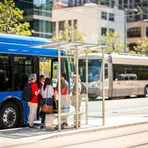
A system of buses and trains that carries people around a city
 16
1.9
16
1.9
A system of buses and trains that people use to travel
 9
8.5
9
8.5
A city's public transport system like buses or trams
 2
2.7
2
2.7
An organized service of buses or trains that people use to travel
How Extensive

Surface Forms
Morphology
The meaning 'buses, trains, subways, and other transportation services that anyone can use' is directly and compositionally derived from 'public' (accessible to everyone) + 'transport' (movement services). This compound follows a straightforward noun-noun composition pattern found across languages and in basic English, so a B1 learner who knows both constituents will readily infer the MWE's meaning.
Etymology
Public transport comes from the simple idea of vehicles that carry people for the whole town: public means 'for everyone' and transport means 'to carry'. Long ago, coaches, trams and buses ran on fixed routes and charged a small fare, so the term now means buses, trains and other services that 'anyone can use' usually 'for a fee'.