

pterosaur
 5
9.9
5
9.9

- noun
- /ˈtɛrəˌsɔr/
- Some pterosaurs, like the Quetzalcoatlus, had wingspans as wide as 33 feet.
- wings of a pterosaur
- pterosaurs with wingspans
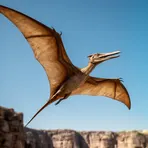
- pterosaurs: flying reptiles
Examples
-
Padian says he believes the smaller pterosaurs were bipedal and therefore took off with two legs instead of four.
Blog text (7) -
In Northern Pennsylvania, a string of reports of a pterosaur-like creature made regional headlines during the early '80s.
-
Did you know that the Pterosaur has no natural predators?
-
The Pterosaur lives a charmed life.
-
Pterosaurs lose these when they reach maturity.
-
It's the largest pterosaur.
-
I saw the pterosaur circling a carved structure cut into a natural ledge.
-
Some of the pterosaurs rode on the diplos' huge, uncaring backs.
Fiction book (2002) -
But as the orniths approached, coelurosaurs scuttled away, and pterosaurs flapped awkwardly into the air.
Fiction book (2002) -
Pterosaurs were known for their distinctive bird-like beaks and large membranous wings.
Synonyms
 43
9.7
43
9.7
A flying reptile from long ago with a long thin head and short tail


 1
8.5
1
8.5
An extinct animal with wings like a bat made of skin and supported by one long finger
Surface Forms
Morphology
pterosaur = ptero + saur
Built from Greek combining forms ('ptero-' + '-saur') that are not standalone English words, so the composition is not transparent to an average B1 learner.
Etymology
Pterosaur comes from the Greek parts pteron ('wing') and sauros ('lizard'), the same sauros you see in dinosaur. So pterosaur literally means 'wing lizard', which explains why it is a flying reptile.