
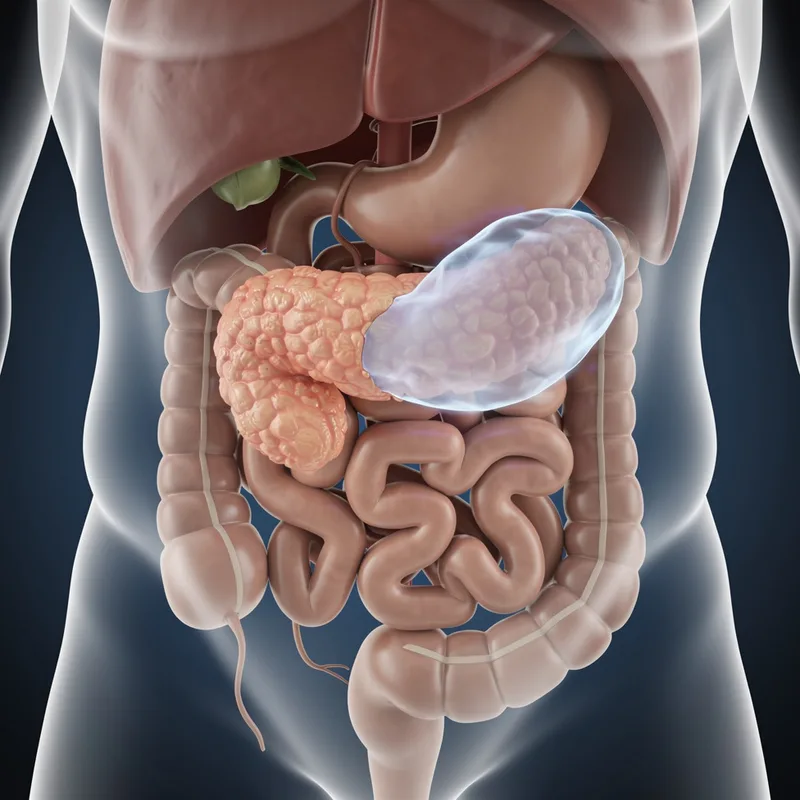
pseudocyst
 2
9.0

- noun
- /ˈsuːdoʊˌsɪst/
- Specialized
- When the diagnosis of CP is in question, or if there is concern for other pathology such as a pseudocyst or mass, then cross-sectional imaging of the gland is often obtained.
- pancreatic pseudocyst
Examples
-
The doctor explained that a pseudocyst can form as a reaction to inflammation in the pancreas.
-
Obstructive stones, plugs, strictures, and pseudocysts.
Academic text (2017) -
These include the ability to drain pancreatic pseudocysts, occurring in 20-40% of patients, as well as performing necrosectomies in severe cases of necrotizing pancreatitis.
Academic text (2017) -
Histologic examination revealed that these lesions were pseudocysts lined with nonepithelial layers, filled with mucus, and limited by granulation tissue.
Academic text (2003) -
Up to 95% resection, disease in body/tail, and best those with pseudocysts; suggestion that if the spleen can be spared, disease is less severe, hence lower rates of diabetes with spleen-sparing procedures.
Academic text (2017) -
A recent scan revealed a large pseudocyst in his abdomen that required further evaluation.
-
After the surgery, she developed a pseudocyst that was monitored closely by her medical team.
Surface Forms
Morphology
Etymology
The word pseudocyst comes from the parts pseudo- meaning 'false' and cyst meaning 'sac' or 'bladder'. So, a pseudocyst is a 'false sac', a fluid pocket that looks like a cyst but does not have a true lining.