

pseudarthrosis


 1
9.9
- noun
- /ˌsuːdoʊˈɑrθroʊsɪs/
- Specialized
- Osteomas have been classified into three types on the basis of gross specimen examination: nonmovable, with a firmly attached broad base (the most common type); movable, often with a pedicle or a pseudarthrosis; and movable with no attachment.
Examples
-
The remodeling was obscured by pseudarthrosis.
-
Pseudarthrosis occurs when a broken bone does not heal properly and creates a pseudarthrosis.
-
Pseudarthrosis is the formation of a "false" joint at the fracture site.
Academic text (2002) -
Patients with pseudarthrosis often experience pain and limited mobility at the fracture site.
-
In some cases, pseudarthrosis can complicate surgical interventions aimed at repairing fractures.
Synonyms
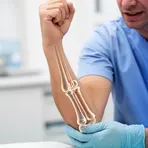
A broken bone that does not heal and forms a false joint where it broke
Surface Forms
Morphology
pseudarthrosis = arthrosis (transparent) = pseudo + arthr + osis
The word is transparently formed as pseudo- + arthrosis, yielding the literal sense of a false joint.
Etymology
Pseudarthrosis comes from pseudo- 'false' and arthrosis 'joint', the same arthro- you see in arthritis. So pseudarthrosis literally means 'false joint', which fits when a broken bone does not heal and instead forms a joint-like, movable area.