
protoplanet
- noun
- /ˈproʊtəˌplænɪt/
- Specialized
 :
protoplaneta
:
protoplaneta
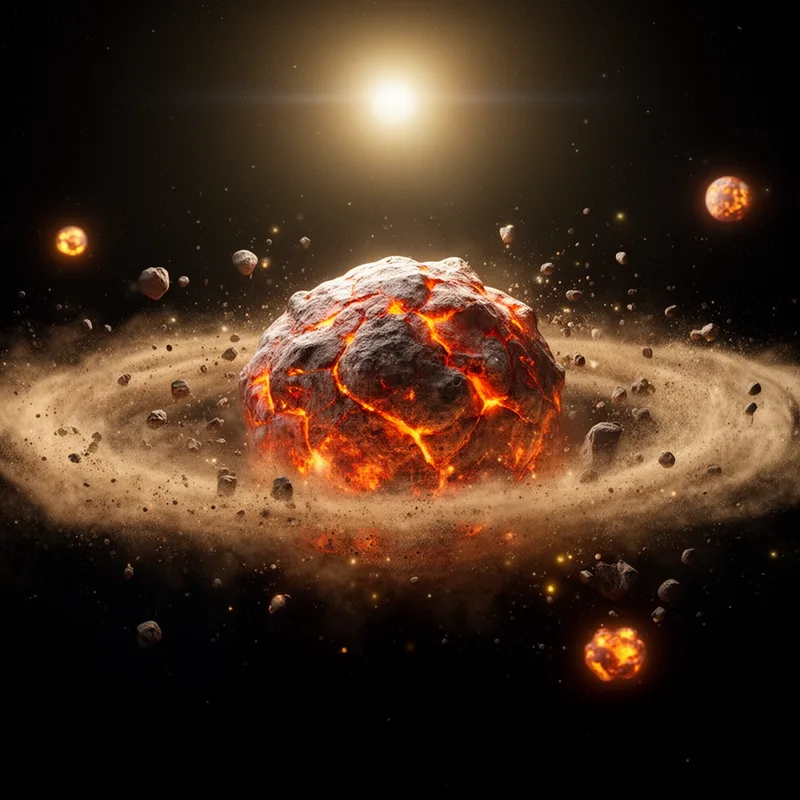
- As protoplanets collide and accumulate material, they contribute to the formation of planets.
- protoplanets orbiting
- giant protoplanet
- solid protoplanets
It was so long ago that we called it protoplanet day.
- It was so long ago that we called it protoplanet day.
Examples
-
Some of these protoplanets grew into the planets we know today, but many more collided with each other, breaking into pieces.
-
They had protoplanets orbiting them when I left.
Fiction book (1998) -
So when our moon was created, well, you remember that, Yeah, this Mars sized protoplanet sideswipes Earth, right?
-
That each individual protoplanet has a unique isotopic fingerprint.
-
These clumps do not make protoplanets.
Academic text (2005) -
Boss asserts that fragments so formed will become permanent, gravitationally bound gas giant protoplanets.
Academic text (2005) -
Some researchers claim these clumps become gas giant protoplanets, but in our simulations, the clumps do not last.
Academic text (2005) -
Again, I don't know how you can't get excited about the fact that JWST should be able to just, you know, peer through through this dust and watch protoplanets being born.
-
The advantage of invoking GIs to make planets is that, if the mechanism works, it could produce protoplanets within only hundreds or thousands of years, rather than the several millions of years required for core accretion.
Academic text (2005) -
In the early solar system, a protoplanet formed as dust and gas gradually clumped together in space.
How Developed


Surface Forms
Morphology
Etymology
Protoplanet combines two parts: proto- meaning 'first', like in prototype, and planet meaning 'wanderer' or the bodies we call planets. So a protoplanet is a 'first' or early planet, a young body that gathers dust and gas as it grows into a full planet.