
protandrous
- adjective
- /proʊˈtændrəs/
- Specialized
- Conversely, when the mating system is monogamous, female reproductive success increases more rapidly with size than male reproductive success does. Therefore, a small individual would be better off as a male, and a large individual as a female, resulting in male to female (protandrous) sex change (Warner 1988).
- protandrous sex
- protandrous sex change
Examples
-
The trouble with all this understandable humanizing of the characters is that in nature, clownfishes are protandrous hermaphrodites.
Academic text (2005) -
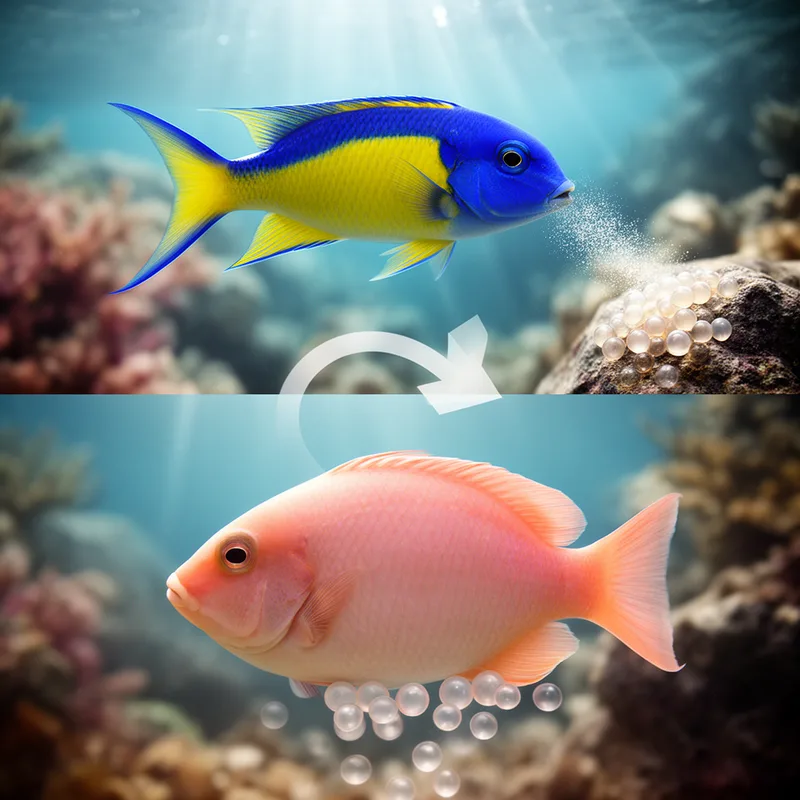
Clownfish are known to be protandrous because they start their lives as males and can change to females later.
-
In these situations, a small individual would be better off as a female, and a large individual would be better off as a male, resulting in female-to-male (protandrous) sex change (Warner 1988).
Academic text (2013) -
The classic model of sex change, the SAH, predicts that species showing polygyny should exhibit a protogynous sex allocation pattern, whereas those showing monogamy should exhibit a protandrous pattern.
Academic text (2013) -
Some fish species exhibit protandrous reproduction, where males transition to females as they grow larger.
-
In protandrous species, individuals often begin as males, adapting their role as they age and grow.
Surface Forms
Morphology
protandrous = protandry (semi-transparent) = prot + andr + ous
The suffix '-ous' indicates an adjective form, but the biological concept may not be immediately clear to all learners.
Etymology
Protandrous comes from the parts proto- meaning 'first' and andro- meaning 'male', with proto- like the 'first' in prototype. So, protandrous describes animals that are 'male first' and later become female.

