

prosthetic device
 1
4.1
1
4.1

- noun
- /prɒsˈθɛtɪk dɪˈvaɪs/
- Specialized
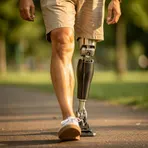
- Many athletes use prosthetic devices to participate in sports after losing limbs.
Examples
-
Other applications include robotic legs, arms, and hands, both as prosthetic devices and as exoskeletons.
Academic text (2007) -
As a part of this activity, students will fabricate, fit, maintain, and repair artificial limbs, plastic cosmetic appliances, and other prosthetic devices, according to specifications and under the guidance of the instructor, who in this case will serve as the patient needing the prosthetic.
Academic text (2009) -
First of all, the big issue is what kind of prosthetic device should we use?
-
Patients had their present prosthetic device for a minimum of one year.
Academic text (1995) -
Prosthetic devices are designed to enable the person to function in a more normal way.
Academic text (2004) -
Is there a student in your music class who uses a prosthetic device to help them perceive sound?
Academic text (2009) -
Placement of prosthetic devices, both off-the-shelf and custom-fabricated, has often substituted for surgical intervention.
Academic text (2007) -
The client functioned so well with a prosthetic device that a court found he was not disabled under the "mitigating measures" standard set forth in Sutton.
Academic text (2002) -
Devices include artificial limbs, such as the Rheo Knee System from Ossur and Boston Digital Arm System from Liberating Technologies Inc., and neural prosthetic devices in development at the University of Southern California and elsewhere.
Academic text (2007) -
The advanced prosthetic device allowed her to walk again after the accident.
Synonyms
 15
4.6
15
4.6
An artificial device that replaces a missing body part such as a leg
 14
6.0
14
6.0
A thing that replaces a missing body part like a leg, tooth, or eye
How Functional
- Specialized
1
4.1
 4
3.2
4
3.2
Surface Forms
Morphology
The meaning 'an artificial device that replaces a missing or damaged body part' is directly and transparently derivable from 'prosthetic' (relating to replacements for body parts) combined with 'device' (a manufactured item for a practical purpose). This compositional, medical/technical pattern is clear and cross-linguistically familiar, so a B1 learner who knows both constituents would readily infer the phrase's meaning.
Etymology
Prosthetic device comes from a Greek word that meant 'to place' or 'to add' something to the body. So a prosthetic is something made to be put in the place of a missing part and a device is a tool, which is why the phrase means 'an artificial replacement for a missing body part'.