

proscenium
 3
9.1
3
9.1

- noun
- /prəˈsiːniəm/
- Specialized
- Marcel Janco's now-lost painting of the Cabaret Voltaire, too, shows the stage as a proscenium large enough for an upright piano and no less than seven performers.
- proscenium arch
Examples
-
Just like that: the audience walking through an invisible proscenium onto a floor-level stage.
Fiction book (2000) -
The engraving shows the proscenium completely open.
Academic text (1995) -
Poets found themselves on the proscenium for the last time.
Academic text (2000) -
There is no proscenium; there is no scenery.
Academic text (1998) -
That's some nice plaster work around the proscenium there.
-
In Collier's text, the play begins when Punch pops up into the proscenium.
Academic text (1995) -
For if I had been erect when a portion of one of the flies dropped from the proscenium arch, it would have hit my head.
Fiction book (1992) -
Here, Guarini created a proscenium through which we apprehend the sacred theater of the Shroud.
Academic text (1995) -
Here we see how Guarini's enframing devices of the fluted columns and depressed arch functioned as a proscenium for ceremonial exhibition.
Academic text (1995) -
The proscenium arch helps define the stage and separate it from the audience.
Synonyms
 7
7.3
7
7.3
A flat area beside a stage, golf green, or runway where people and vehicles move


 1
8.6
1
8.6
An arch over a stage that makes a frame between the actors and the audience

A part of a theatre that separates the stage from the audience and holds the stage opening
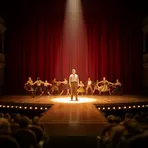
The front part of a theater stage that extends in front of the curtain
Compounds
- Specialized
1
8.6
An arch over a stage that makes a frame between the actors and the audience
- Specialized
A part of a theatre that separates the stage from the audience and holds the stage opening
How Central

Surface Forms
Etymology
Proscenium comes from Greek parts pros- meaning 'in front of' and skēnē meaning 'stage' or 'scene', and you can see the same root in the English word scene. So proscenium literally means the area 'in front of the stage', which is why it names the front part of a theatre stage or the arch that separates actors from the audience.