
prokaryotic


 1
8.1
- adjective
- /proʊˌkɛr.iˈɑː.tɪk/
- Specialized
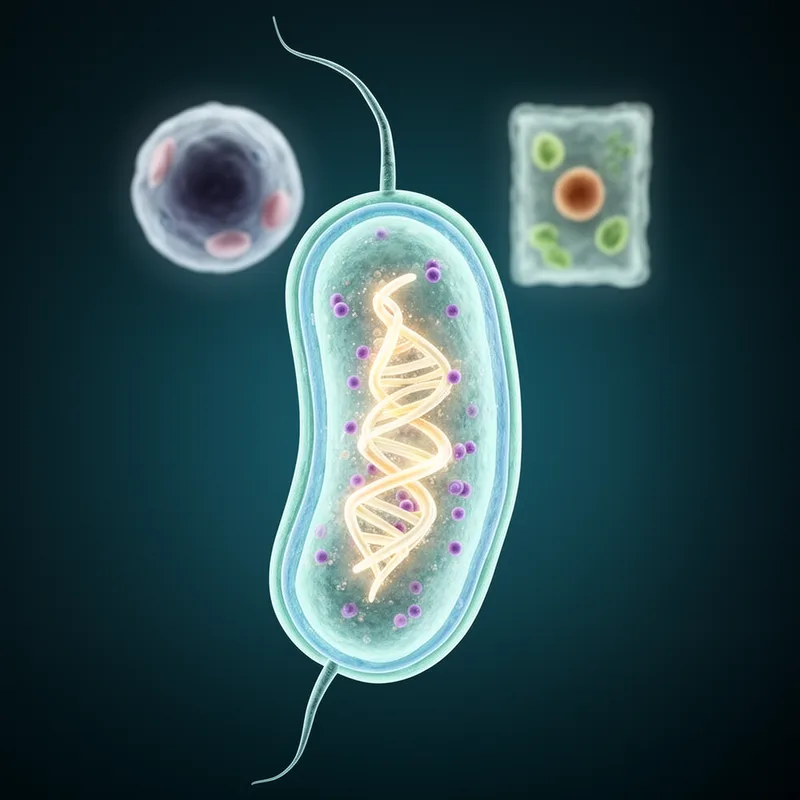
- The earliest organisms were prokaryotic—simple cells whose genes do not reside in a membrane-bound nucleus.
- prokaryotic cell
Loading YouTube…
Watch on YouTubeThis is how you go from single cell eukaryotic to prokaryotic or the other way around.
- This is how you go from single cell eukaryotic to prokaryotic or the other way around.
Examples
-
The prokaryotic world was genetically diverse, but it certainly didn't have this kind of morphological diversity in it.
-
Animal or vegetable, all prokaryotic cells contained circular chromosomes, free of nuclear membranes—like bacteria, prokaryotes.
Fiction book (1998) -
All of the rest of the cells on the planet are prokaryotic, which means before the nucleus.
-
This is how you go from single cell eukaryotic to prokaryotic or the other way around.
-
But prokaryotic cells were ring-shaped as well.
Fiction book (1998) -
Many researchers believed that prokaryotic organisms like bacteria probably did not contain clocks.
Academic text (2005) -
Most importantly, Whittaker now accepted Copeland's earlier decision to place all prokaryotic organisms into their own kingdom.
Academic text (2012) -
Many textbooks recognize a new kingdom for the archaea, but both the archaea and bacteria are typically discussed in the chapter devoted to prokaryotic life.
Academic text (2012) -
As a result, Margulis and Chapman continued to argue for maintaining a prokaryotic superkingdom that includes both bacteria and archaea.
Academic text (2012) -
Many researchers believe that prokaryotic cells, like bacteria, lack complex organelles.
Synonyms
 1
8.5
Having cells that do not have a membrane around their nucleus, like bacteria
Antonyms
How Complex

Surface Forms
Morphology
prokaryotic = prokaryote (semi-transparent) = pro + karyote + ic
This is a standard adjective formed from the noun 'prokaryote' and means 'relating to or having the nature of a prokaryote'.
Etymology
Prokaryotic comes from the parts pro- meaning 'before' and karyon meaning 'kernel' or 'core'. So a prokaryotic cell is 'before the nucleus' and does not have a membrane-bound nucleus, which is why bacteria are called prokaryotic.