

proboscis monkey
- noun
- /prəˈbɑsɪs ˈmʌŋki/
- Some of them, like the proboscis monkey (Nasalis larvatus) and the gentle gray lemur (Hapalemur griseus), spend much time in the water, as well as on the ground and in the trees.
- proboscis monkey (Nasalis larvatus)
- male proboscis monkey
Examples
-
That is the proboscis monkey of Borneo.
Academic text (1995) -
The descendants of any survivors would have had to adapt to a habitat not unlike that of the proboscis monkey.
Academic text (1995) -
The proboscis monkey is endemic to coastal mangroves, swamps, and riverine areas.
Academic text (2008) -
The big, bulbous nose of the adult male proboscis monkey consists of erectile tissue that fills with blood when he is excited.
-
The proboscis monkey needs large tracts of forest to sustain its dwindling populations on Borneo.
-
Endowed with one of nature's most outlandish noses, a proboscis monkey munches a tender leaf.
Synonyms
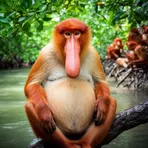
A large monkey from Borneo with a very long nose and reddish brown fur
How Big


Surface Forms
Morphology
The compound simply names a monkey that has a proboscis: 'proboscis' (an extended snout) + 'monkey' yields a monkey with a long/bulbous nose, so the meaning is directly compositional. This descriptive noun–noun pattern is predictable and cross-linguistically common, so a learner who knows both constituent words can infer the MWE meaning.
Etymology
Proboscis monkey gets its name from proboscis, a fancy word for a long nose or 'trunk', because male monkeys have a very large, hanging nose. That's why the name points to the monkey's most noticeable feature.