
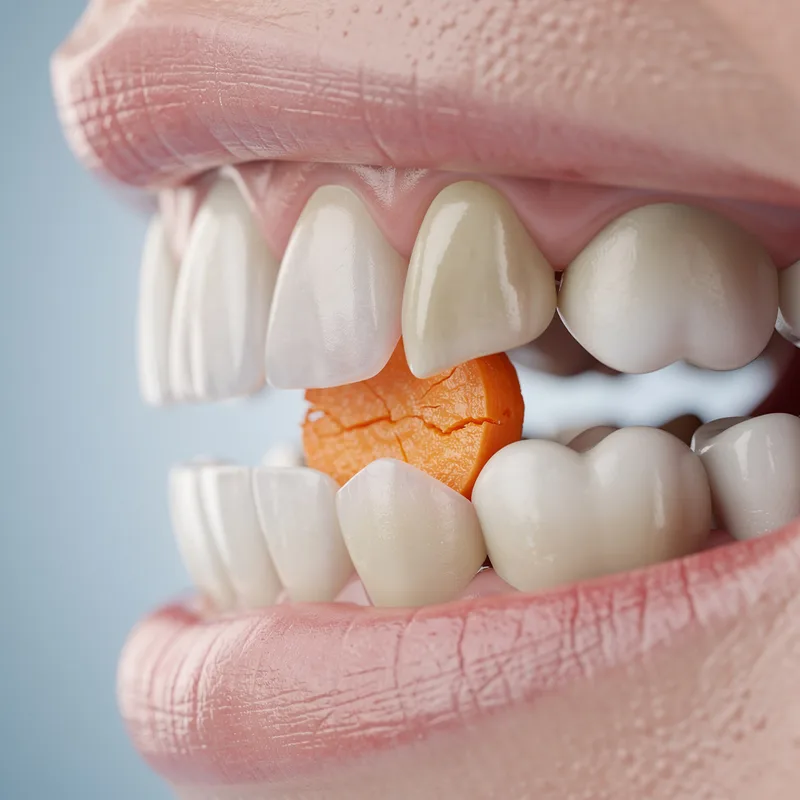
premolar
 2
4.0
2
4.0

- noun
- /ˈpriːˌmoʊlər/
- Specialized
- As their name implies, most carnivorans eat meat, and even those that aren't carnivorous—such as the giant panda—can be recognized by the last upper premolar and first lower molar on each side of the mouth.
Examples
-
The canine teeth are not sharp and pointed but shaped more like what one would expect premolars to look like, while the incisors are small, peglike, and closely packed.
Academic text (1991) -
During the examination, the doctor pointed out the premolars that were sensitive to pressure.
-
The premolars are broad and flat and resemble molars.
Academic text (1991) -
The development of the premolars, a permanent molar, and an incisor matches those of modern girls and boys around the age of 7.5 years.
Academic text (2009) -
The premolars were collapsed inward just enough that my lower jaw didn't fit properly into my upper arch and had to be held back.
Blog text (16) -
Four teeth were borrowed for study from the British Museum (Natural History) and the Senckenberg Natural History Museum in Frankfurt: an upper incisor, lower canine, lower premolar, and lower molar.
Academic text (1991) -
The dentist explained that the premolar is essential for grinding food.
-
Each side of your mouth has two premolars that play a key role in chewing.
Synonyms
 ∞
1.0
∞
1.0
A hard white part in the mouth used for biting and chewing
 3
7.4
3
7.4
A tooth with two small points between the front teeth and molars
 1
2.2
1
2.2
A tooth at the back of the mouth, like a molar


 1
6.8
1
6.8
A tooth at the back of the mouth like a molar
How Back
17
3.2
 26
2.5
26
2.5
- Specialized
1
6.8
- Specialized
2
4.0
9
3.8
12
3.6
Surface Forms
Morphology
Etymology
Premolar is made of pre- meaning 'before' and molar, the back tooth that comes from a word for 'mill' or 'millstone'. So a premolar is a tooth 'before the molars' that helps grind food.