
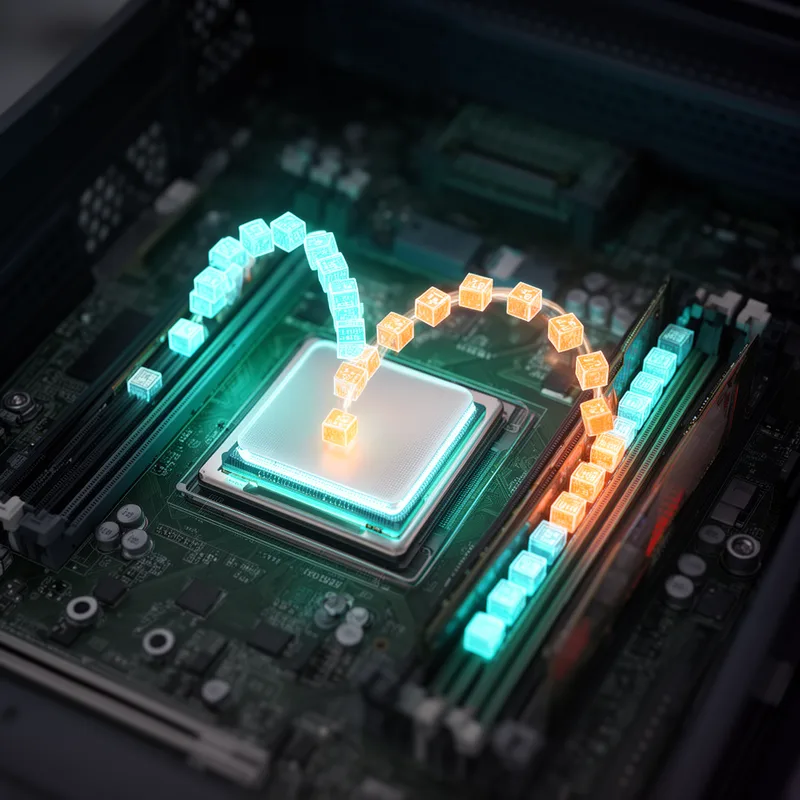
prefetching
- noun
- /ˈpriːˌfɛtʃɪŋ/
- Specialized
- Implementing prefetching helped the game run smoother by reducing load times during play.
- algorithmic prefetching
- hardware-assisted prefetching
- prefetching technique
Examples
-
The new software uses prefetching to load data before it's needed, significantly speeding up the application.
-
The graphs on the left do not use prefetching; the graphs on the right do.
Academic text (1997) -
As far as we know, this use of prefetching is novel.
Academic text (1997) -
As pointed out earlier, because of multiple function units on POWER2, prefetching is easier.
Academic text (1994) -
We can still use prefetching; however, not to hide latency but to improve memory bandwidth.
Academic text (1997) -
The subroutine must know the cache line size of the machine in order to do optimal prefetching.
Academic text (1994) -
In particular, we use prefetching to prevent multiple load/store units from stalling on the same cache line.
Academic text (1997) -
Finally, 2-by-2 blocking combined with prefetching yields performance of 93-104 MFLOPS.
Academic text (1997) -
The 1-by-2 blocking with no prefetching improves performance to 70-77 MFLOPS, and prefetching combined with 1-by-2 blocking boosts performance to 78-98 MFLOPS.
Academic text (1997) -
The engineer explained that prefetching optimizes system performance by preparing resources in advance.
How Proactive
- Specialized

- Specialized
Surface Forms
Morphology
Etymology
Prefetching comes from pre- ('before') and fetch ('to get'), so it literally means 'getting something in advance'. That's why, in computers, prefetching is the process of loading data before it is needed to make programs run faster.

